
You'll have seen the Anthropic Super Bowl ad.
I did a quick data scrape of this FT article.
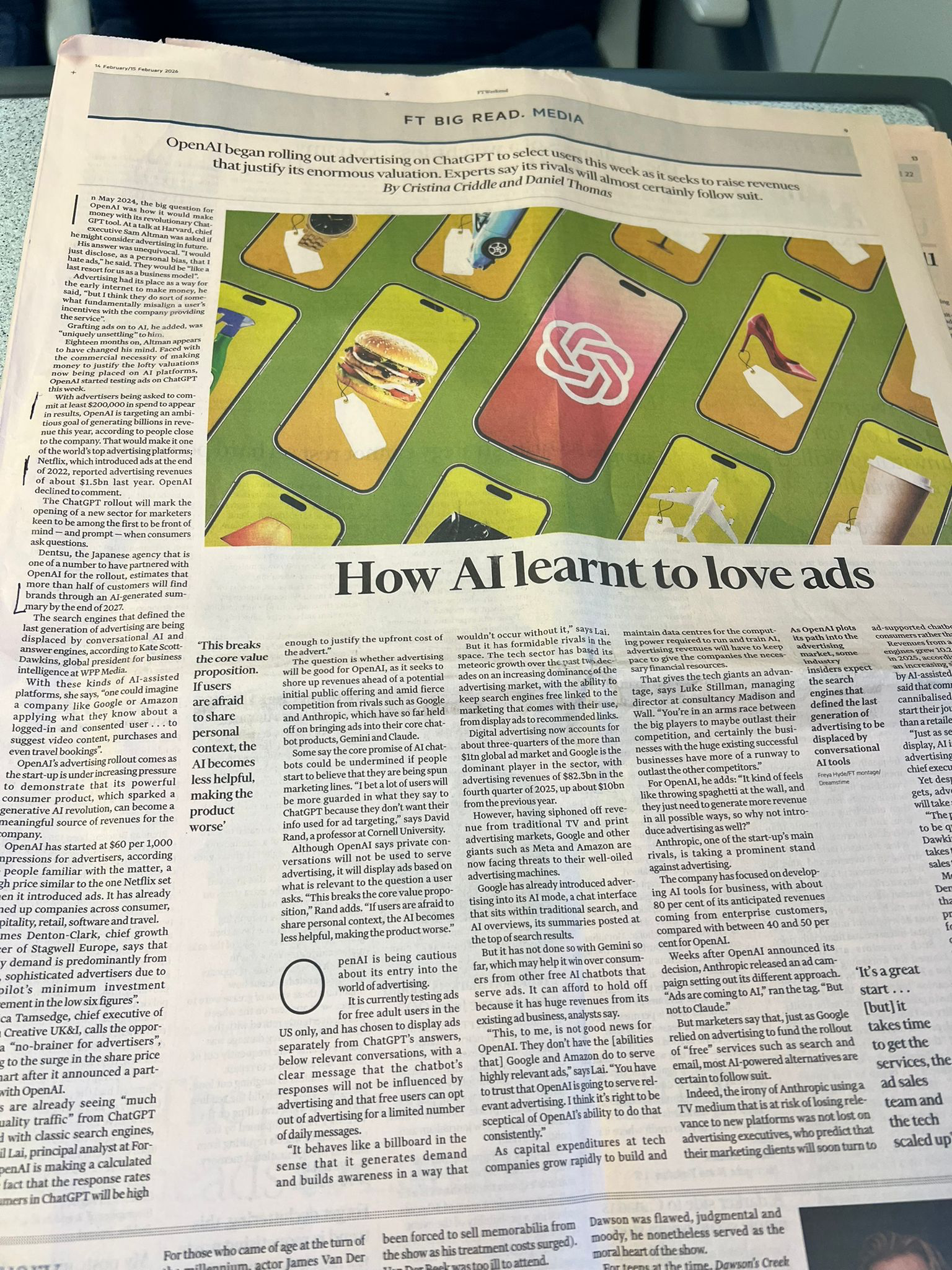
Main bits:
'I would just disclose, as a personal bias, that I hate ads, they would be like a last resort for us as a business model. Advertising had its place as a way for the early internet to make money...'but i think they sort of somewhat fundamentally misalign a user's incentives with the company providing the service'
That was Sam Altman in 2024.
OpenAI has asked advertisers to commit an initial £200k in order to appear in ChatGPT results. The CPM is quoted around $60 per 1000 impressions.
Is this the creation of a whole new ad market? Comparisons are made with Netflix launching an ad-tier. The revenue from this was $1.5billion in 2025.
More than half of customers will find brands through AI generated summary by end of 2027.
Questions arising:
Is this enshittification in real time? Do ads in the chat undermine confidence in the results?
See 🤖 note on Enshittification here
Enshittification and Sports Media: A Cautionary AnalysisThe Strategic Bet
Sports rights holders increasingly view YouTube/Google as a growth engine for digital reach. The logic seems sound: massive built-in audience, sophisticated recommendation algorithms, global distribution, and revenue share from advertising. Free hosting for highlights. Live streaming infrastructure without capital expenditure.
Applying Doctorow's framework, this strategy deserves serious scrutiny.
Stage One: The Seduction
YouTube's initial offer to sports rights holders mirrors Facebook's pitch to publishers circa 2010:
"Come over to my platform... I know you're all using [traditional broadcast] but... we will never spy on you"
The platform offer is genuinely attractive:
- Free distribution at global scale
- Algorithmic amplification that surfaces your content to new audiences
- Monetisation infrastructure without building your own ad sales team
- Analytics and data on viewing behaviour
- Lower friction than building direct-to-consumer products
Sports organisations pile in. They build subscriber bases. They train fans to expect content there. The audience grows.
The Lock-In Mechanism
Here's where Doctorow's collective action problem becomes critical for sports:
"You love your friends but like even the six people in your group chat can't agree on where you're going to go for a beer on Friday"
Translate this to sports fandom:
- Fans follow their team's YouTube channel because that's where the highlights are
- The team posts to YouTube because that's where the fans are
- Fan communities form in comments sections and around YouTube content
- Third-party creators build audiences reacting to and discussing official content
- The algorithm learns what fans want and serves them more
The audience becomes YouTube's asset, not the rights holder's. The subscriber count, the watch history, the engagement data, the recommendation graph - all of this sits on Google's servers, governed by Google's terms.
Sports organisations face the same trap as publishers:
"Publishers meanwhile they found that they had to put more and more of their content on Facebook just to have it show up for the people who'd actually subscribe to their feeds"
Stage Two: Turning the Screws
Once dependency is established, the platform's incentives shift. Doctorow describes how Facebook treated publishers:
"You couldn't even have a link back to your own website because maybe that's a dangerous link right a deceptive link... eventually it's got to be the whole substitutive content no link back to your website"
For sports, the screws might look like:
Algorithm manipulation: Your content's reach becomes a function of how well it serves YouTube's goals, not yours. Doctorow cites Amazon's search manipulation:
"The top result on an Amazon search results page is there because they paid more than everyone else it's not because it's the best match for your search"
YouTube already operates this way. Reach is increasingly pay-to-play. Organic distribution declines. You must buy ads on the platform to reach the audience you built on the platform.
Revenue share erosion: The 55/45 split that seemed generous becomes 50/50, then 45/55. Ad rates fluctuate based on Google's priorities, not yours. Doctorow notes:
"Advertising prices go way up advertising fidelity goes through the floor advertising ad fraud explodes"
Direct competition: YouTube has already bought NFL Sunday Ticket and MLS rights. The platform that was your distribution partner is now your competitor for the same inventory. They have perfect information about what your content is worth because they've been measuring it for years.
The Monopsony Problem
This is perhaps the most under-appreciated risk. Doctorow explains:
"A 20% share as a monopsinist is basically dispositive it gives you total control 20% share as a monopolist is just an inconvenience for your customers"
If YouTube becomes where a significant portion of sports fans consume digital content, the power dynamic inverts completely. Rights holders must be on YouTube to reach fans. YouTube knows this. Every negotiation happens with that leverage.
The sports parallel to Doctorow's coffee shop analogy:
"Imagine you know there's a block with like five coffee shops on it... that coffee shop has an office building next door like this one and 20% of their gross receipts come from the people in the office building and one day that business goes under... the coffee shop is probably out of business"
What happens when YouTube changes its algorithm and your highlights reach drops 40%? What happens when they decide live sports should be behind YouTube Premium? What happens when they renegotiate revenue share?
You're the coffee shop. They're the office building.
The Economy-Wide Tax
Doctorow describes how Amazon's practices raise prices everywhere:
"Because of most favored nation they have to raise prices at Target at Walmart at the factory store and at your local convenience store so this is an economywide tax"
In sports media, the equivalent might be:
- If YouTube's ad rates set the benchmark for digital sports content value, they set it for everyone
- If fans are trained to expect free content on YouTube, they resist paying elsewhere
- If YouTube's recommendation engine determines what content gets made (because that's what gets views), editorial independence erodes
- If YouTube takes a significant cut of digital revenue, that cost gets passed through the entire sports media ecosystem
What History Tells Us
Doctorow is explicit about what happened to publishers who followed this path:
"This is what destroyed the media industry"
The pattern was:
- Free distribution and traffic seemed like a gift
- Publishers became dependent on platform reach
- Platforms changed the rules (pivot to video, algorithm shifts, news feed changes)
- Publishers who had hollowed out their direct distribution capabilities had no fallback
- Value flowed to platforms, publishers collapsed
The ad fraud revelation is particularly stark:
"Proctor and Gamble in 2017 they zeroed out their annual $200 million spend on programmatic advertising surveillance advertising they saw a zero drop in sales that is such a wild stat it's like to a first approximation no one saw the ads it just disappeared down the fraud hole"
If P&G's $200 million in digital advertising produced zero measurable effect, what confidence should sports rights holders have that their YouTube strategy is building real, transferable value?
The Counter-Arguments (And Why They May Be Wrong)
Sports rights holders might argue they're different:
"Live sports is appointment viewing, not disposable news"
But the valuable content being given to YouTube isn't live rights - it's highlights, behind-the-scenes, shoulder programming. This is precisely the content that trains fans where to find your brand. And increasingly, live rights are going to platforms too.
"We have contractual protections"
Publishers had contracts too. Contracts expire. Leverage shifts. And contracts don't protect against algorithm changes, revenue share adjustments within agreed ranges, or the platform deciding to compete directly for your rights.
"Our brand loyalty is stronger than news publishers"
This may be true for the core fan. But the growth audience - the casual viewer, the new market, the next generation - their loyalty is to convenience. If they learned to find you on YouTube, that's where they'll look. You didn't build loyalty to your brand; you built loyalty to the platform experience.
"We need to be where the audience is"
This was Facebook's pitch to publishers verbatim. Doctorow's response:
"It's just not you're not going to shop your way out of a monopoly right that's like saying you're going to like recycle your way out of the wildfires"
The Brittle Equilibrium
Perhaps most troubling is the instability of the current arrangement. Doctorow describes the precariousness:
"The difference between god I hate Facebook but I can't seem to stop logging into it and god I hate Facebook I'm never going back again it's very thin"
YouTube's dominant position in digital video isn't guaranteed. Regulatory action, a competitor (TikTok before bans, whoever comes next), a scandal, or simply a strategic pivot by Google could reshape the landscape overnight.
If that happens, what do sports rights holders own?
- Not the subscriber relationships (those are YouTube accounts)
- Not the viewing data (that's on Google's servers)
- Not the recommendation graph (that's YouTube's algorithm)
- Not the payment relationships (that's YouTube Premium, YouTube TV)
You own the rights. But you've trained a generation of fans to consume those rights through infrastructure you don't control, can't influence, and could lose access to.
What Would Doctorow Advise?
Based on his framework, the answer is about adversarial interoperability and owning your relationship with the audience:
"Why is Facebook in charge of what you see when you look at Facebook"
Translated to sports: Why is YouTube in charge of what fans see when they look for your content?
The strategic imperative would be:
- Build direct-to-consumer infrastructure even if it's smaller than platform reach
- Capture first-party data on every fan interaction possible
- Use platforms for acquisition, not retention - get fans onto owned channels
- Diversify platform presence so no single platform has monopsony power
- Retain premium content for owned distribution, give platforms only what drives traffic elsewhere
- Negotiate data rights as aggressively as revenue share
The question for sports executives is whether the short-term reach gains from YouTube are worth the long-term strategic dependency.
Conclusion
Doctorow's enshittification framework suggests that giving valuable sports content to YouTube is not a growth strategy - it's a value transfer strategy. The growth accrues to the platform. The lock-in traps the rights holder. The extraction phase hasn't arrived yet, but the infrastructure for it is being built with every subscriber gained, every highlight posted, every fan trained to expect content there.
"These are like the foreseeable and foreseen outcomes of specific policy choices made in living memory by named individuals who were warned at the time that this would happen"
Sports executives making platform distribution decisions today are those named individuals. The question is whether they're listening to the warning.
The counter argument - 'Ads are why we have nice things'
Yeah but.
🤖 Summary of the Andressen Horowitz position
The Pro-Advertising Argument for ChatGPT
Source Context
This article is from a16z (Andreessen Horowitz), a major investor in OpenAI. The conflict of interest is material: a16z needs OpenAI to find sustainable monetisation to justify their investment and generate returns. The article should be read with this lens.
Key Arguments Summarised.
- Ads as Public Good
The central framing positions advertising as democratising rather than extractive:
"Ads are why we have nice things... the internet has always run on ads and most people like it that way."
The argument: charging subscriptions limits access to those who can afford $20-200/month. Ads enable universal access.
2. The "Luxury Beliefs" Dismissal
Critics of advertising are characterised as performative rather than principled:
"For all the moralistic hand-wringing over 'Selling data!' or 'Tracking!' or 'Attention harvesting' and other bingo words... People who pretend this is a bad thing usually are trying to prove something to you."
This rhetorical move attempts to delegitimise structural criticism as mere status signalling.
3. The Long Tail Problem
The core business case: most users won't pay because most use cases don't justify payment.
"Most people use AI for personal productivity: things like writing emails, searching for information, and tutoring or advice. Meanwhile, higher value pursuits, like programming, make up a very small percentage of overall queries."
The data cited: 5-10% of 800M weekly active users convert to paid (40-80M people). But to reach "a billion people and beyond" requires an alternative to subscriptions.
4. Users "Actually Like" Targeted Ads
"Ask the average Instagram user, and they'll probably tell you that the ads they get are ridiculously useful: they get served products they actually want and need, and make purchases that actually make their lives better."
5. Historical Inevitability
The article frames advertising as the natural endpoint of all consumer internet products:
"Any internet history buff knows that ads are a core part of how platforms eventually monetize: Google, Facebook, Instagram, and TikTok all started free, and then figured out monetization with targeted ads."
For giggles, I put the A16Z rationale through Claude (see Super Bowl ad above...), and asked it to critique the pro-advertising arguments through the lens of enshittification.
🤖 Critique: Is This Enshittification?
Applying Doctorow's framework to the a16z argument reveals a textbook case of enshittification logic - the article essentially describes the transition from Stage One to Stage Two while framing it as benevolent.
The Three Stages Applied
Stage One (Complete): Attract Users
OpenAI offered a genuinely remarkable product for free. ChatGPT's initial launch was subsidised by investor capital, offering capabilities that felt magical. Users arrived in hundreds of millions.
Stage Two (In Progress): Lock Users In
The lock-in mechanisms are now firmly established:
- Memory: ChatGPT remembers your preferences, past conversations, context about your life
- Workflow integration: Users have built habits, processes, and expectations around the tool
- Skill atrophy: Users who rely on ChatGPT for writing, research, or coding have reduced those muscles
- Switching costs: Moving to Claude, Gemini, or Llama means losing conversation history, retraining preferences, rebuilding context
The a16z article implicitly acknowledges this lock-in when discussing the 800M WAU base as an asset to be monetised.
Stage Three (Announced): Extract Value
The article is explicitly a roadmap for value extraction:
"If you want to get ChatGPT to a billion people (and beyond) for free you need to introduce a product other than subscriptions."
Translation: the current user base will now be monetised through advertising, regardless of whether this serves user interests.
Deconstructing the Article's Claims
Claim: "Ads are why we have nice things"
Doctorow's counter:
"This is what destroyed the media industry"
The publishing industry also believed platform advertising would fund quality content at scale. Instead, it transferred value to platforms while hollowing out the publishers who created content.
Claim: Critics have "luxury beliefs"
This is a rhetorical dismissal that avoids engaging with structural criticism. Doctorow addresses this directly:
"It's just not you're not going to shop your way out of a monopoly right that's like saying you're going to like recycle your way out of the wildfires"
The criticism of advertising isn't aesthetic preference - it's about power dynamics and value extraction.
Claim: "People actually like ads"
The article cites Instagram as evidence. But Doctorow would note the selection bias: people who hated the ads left. Those who remain are either tolerating them or have been successfully habituated. User satisfaction surveys of captive populations don't measure the counterfactual.
More critically, the P&G revelation:
"Proctor and Gamble in 2017 they zeroed out their annual $200 million spend on programmatic advertising surveillance advertising they saw a zero drop in sales"
If $200M in targeted advertising produced no measurable effect, the "people like useful ads" claim deserves scrutiny.
Claim: This is historical inevitability
"Any internet history buff knows that ads are a core part of how platforms eventually monetize"
This frames a policy choice as natural law. Doctorow's response:
"These are like the foreseeable and foreseen outcomes of specific policy choices made in living memory by named individuals who were warned at the time that this would happen"
Google and Facebook chose advertising. They could have chosen other models. The outcomes - surveillance capitalism, attention harvesting, algorithmic manipulation - were not inevitable but designed.
The Conflict of Interest Problem
The article never discloses that a16z is an OpenAI investor, though this is widely known. The entire argument serves a16z's financial interests:
- OpenAI needs to monetise to justify its $150B+ valuation
- Subscriptions have plateaued at 5-10% conversion
- Advertising unlocks the remaining 90%+ of users as revenue sources
- Higher revenue justifies higher valuation
- a16z's investment returns depend on this
When Doctorow describes how platforms "drain the value off of them to harvest it all for the shareholders and the executives," this article is the shareholders explaining why draining value is actually good for everyone.
What the Article Admits
Perhaps most tellingly, the article concedes several points that undermine its own thesis:
Admission 1: Most queries are low-value
"Why would they pay for an answer to questions like 'why is the sky blue'... when previously a Google search would direct you to a good-enough answer for free"
If most AI queries are Google-substitutes, and Google already has advertising, what's the differentiated value? The admission suggests ChatGPT's advantage may be temporary convenience rather than structural superiority.
Admission 2: Power users don't want ads
"Programmers are some of the most committed users of LLMs, with some even calibrating their sleep schedules to optimize for daily usage limits. For these users, a $20 or $200/month subscription doesn't feel exorbitant"
The most valuable users - the ones who generate the most engagement, provide the most training signal, and demonstrate the most transformative use cases - are precisely the ones who will pay to avoid ads. Advertising optimises for the long tail of casual users while potentially degrading the experience for power users.
Admission 3: The ad experience problem is unsolved
"Can you transpose a more 'lean-back' ad experience on Instagram or TikTok into the more engagement-heavy model of using ChatGPT? It's a much harder problem"
The article acknowledges that conversational AI advertising is fundamentally different from feed-based advertising, without a proven model for doing it well.