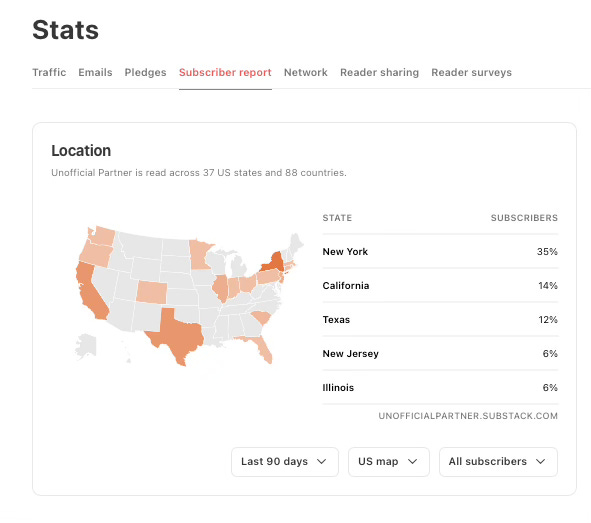
Unofficial Partner is growing rapidly in the US. Substack’s data gives a breakdown of newsletter subscribers, by location:
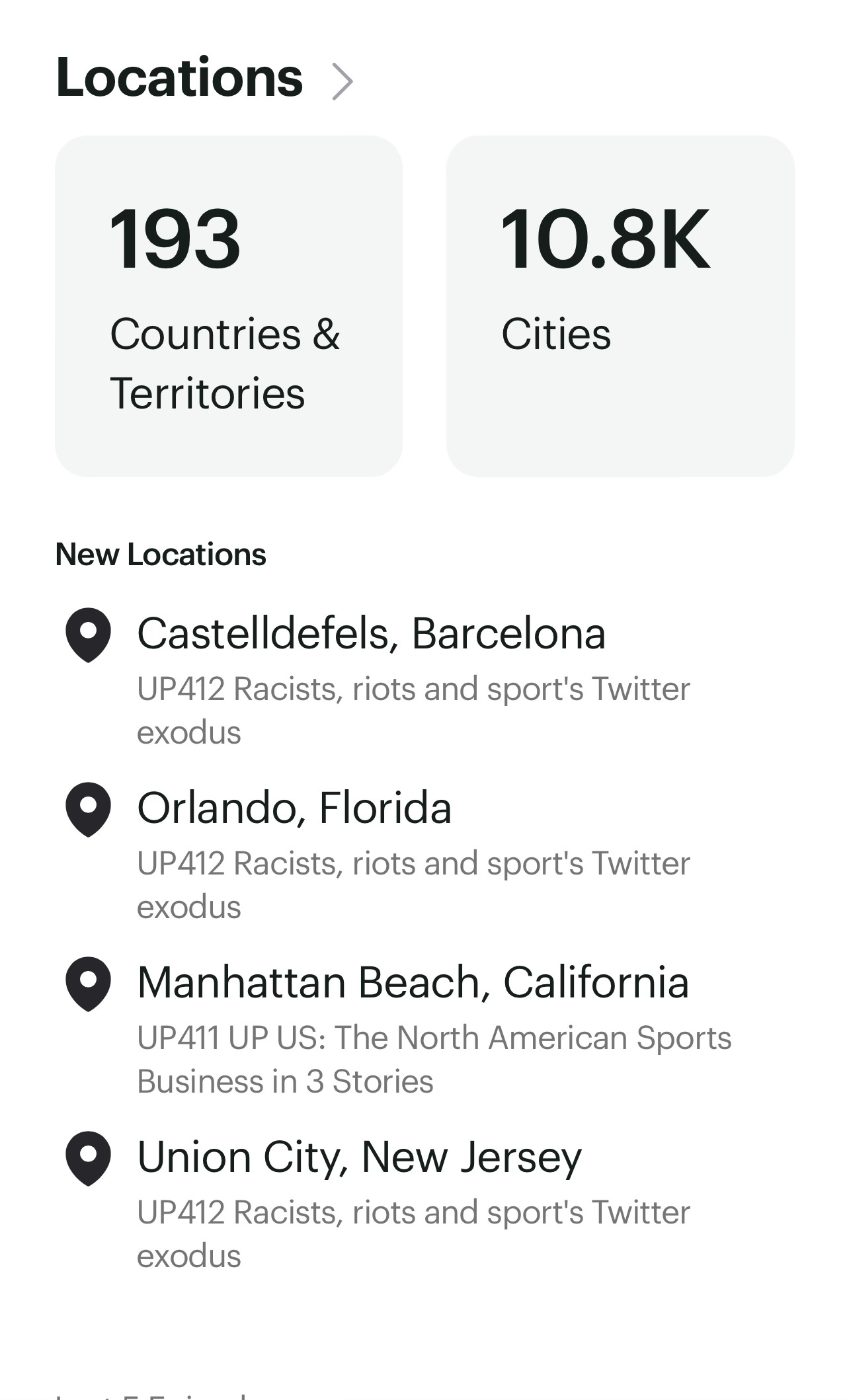
The podcast audience has always been bigger and more widespread than the newsletter, but each week the data shows the same growth trend across North America - see below.
Questions arising
It’s great news that people are finding and sharing the podcast and the newsletter in the biggest and most influential sports marketplace in the world.
The lure of America brings a question, one I’ve been asked in a previous life.
Twenty years ago, I was editor of SportBusiness in London. The company was bought by a group of people keen to court the US market.
Warburg Pincus bit on the sales story and ploughed in millions of OPM, predicated on going head to head with SBJ in the US.
We opened a New York office. Then….nothing.
Spoiler: It failed.
Twenty years on and SBJ remains a big beast in the US market - they bought Leaders to have a foothold in London - and are now competing with a new generation of sports biz platforms such as Front Office Sport, Sportico and a host of Substack newsletters and podcasts of various shapes and sizes.
The US market doesn’t need another new entrant. It’s very well served.
But there is a gap, which we’re filling. To be the place people from that market come to when they’re thinking beyond the US.
It’s really hard to be relevant as a commentator on the business in the US.
We’re not close enough to it, we’re not out and about having conversations, gossipy lunches and after work drinks, testing pet theories and chatting about not-yet-announced new deals and have-you-heard-where-that-bloke-you-can’t-stand-is-going-next whispers.
The other thing that happens is more subtle.
It’s to do with tone of voice.
You start writing for people you don’t really know.
When I write this newsletter I assume a great deal of knowledge on the part of the reader, a version of the Paul Hawksbee Rule: Keep up or fuck off.
Jokes in particular become difficult, because you need to give too much context.
I know the reader.
Or, more accurately, I’ve a very clear idea of who I’m writing to. Sometimes I personalise this, as though writing an email to a mate.
Problems begin when I start to write for an imaginary reader, who I don’t know. I’m guessing. Reaching. The language becomes blander, less colloquial, more generic, less interesting.
All these small details are what collectively get called tone of voice.
In the blizzard of stuff to hit your inbox, I think this is why you’ve clicked on this email and have read this far.
It’s another way of saying that focus is critical to creating something worthwhile.
I remember Two Circles co-founder Claire Rogan once said to me, it’s important to be known as the best at something.
When we started UP, we wanted to be the best sports business podcast and newsletter in the UK.
You’ll have a view as to whether we’re succeeding or not but this is not about that.
Of course, we’ll talk and write about America - but we’ll do it in our own way, from over here.
This week we did a podcast going deep in to three stories in the US marketplace, with Daniel Kaplan, formerly of SBJ, ironically.
And of course, if you’re over there and think that you can help make what we do better, we’d love to hear from you.