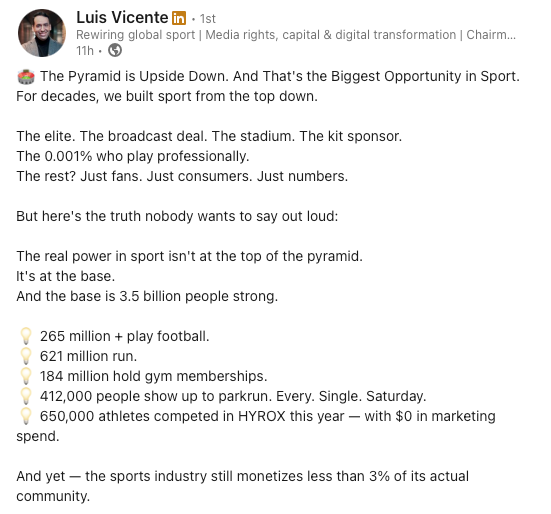
Spotify for Sport anyone?
This is from something Jimmy Iovine said on a podcast.
Since the labels lost control of the formats, tech companies commoditised the product.
Look at the video streaming wars. Netflix, HBO Max, Disney Plus are in a bloodbath. But they have a distinct weapon: Differentiation. If you want to watch Stranger Things, you need Netflix. If you want The Last of Us, you need HBO. Yet, if you look at music: Spotify, Apple Music, Amazon Music, and Tidal all offer the exact same product: A library of 100 million songs. As Jimmy points out in the podcast, this lack of differentiation turns music into a utility. Music is now indistinguishable from tap water or electricity. “Right now, music streaming is a utility,” he says. “All the services are exactly the same, they do the same trick. If one of them lowered their price the rest are toast, because there’s no unique offering.”
So music as utility. Collapse of intangible value (until you get back on the vinyl).
This next bit is on the crappy economics of Spotify:
Here is the financial reality that Wall Street has historically hated about standalone DSPs like Spotify.
In a normal tech business (like SaaS or Netflix), as you gain more subscribers, your profit margins increase exponentially because your fixed costs stay relatively stable. Once Netflix pays $20 million to produce an original movie, that cost is fixed. Whether 1 million or 100 million people watch it, the cost doesn’t change. The margin expands.
Streaming music operates in reverse. Because DSPs pay out roughly 70% of every dollar earned back to rightsholders (labels and publishers), their costs scale linearly with their user base. Every time a song is streamed, a fraction of a cent leaves the building.
Iovine put it bluntly: “The streaming services have a bad situation, there’s no margins, they’re not making any money.”
This model only works for Apple, Amazon, and Google, because they don’t needtheir music platforms to be wildly profitable. Amazon uses music as a loss-leader to keep you paying for Prime. Apple uses it to sell $1,000 iPhones. As for Spotify, or any standalone music streaming company, they’re kind of screwed.
From mass audience to micro communities: The conclusion will resonate with the sports biz.
If Streaming Isn’t the Endgame, What Is?
What if Jimmy is right? If the DSPs are “minutes away from obsolete,” what replaces them? Well, I’m not sure the DSPs are going to disappear overnight, but if you’re an artist or a manager trying to sustain yourself in this evolving music economy, the answer is direct ownership.
The artists who will survive the next five years are the ones who are quietly shifting their focus away from the “ATM Machine.” They are building their own cultural hangars.
They are capturing phone numbers on Laylo. They are driving fans to private Discord servers. They are focusing on ARPF (Average Revenue Per Fan) through high-margin merch, vinyl, and hard tickets, rather than begging for fractions of a penny from a playlist placement.
We are witnessing the death of the “Mass Audience” and the birth of the “Micro-Community.”
The music industry has spent a decade obsessing over how to get a million people to listen to a song once. The next decade will be defined by artists figuring out how to get 1,000 people to care forever.
Jump to: Upside down pyramids