What the end of The FA Player means and what it probably doesn’t mean
The FA Player cost about £2million.
It was the governing body’s owned and operated play, built by StreamAMG.
The death knell for the service was the last WSL rights deal, which went big on YouTube over OTT.
The FA will be criticised, because that’s what The FA is there for. Like the BBC, NHS and the Church of England, they are the biggest institutions in the country, so attract haters like a magnet.
For late arrivals to this substack, I’ve laid out my priors when it comes to the private-public divide in sport. Warning: contains nuance.
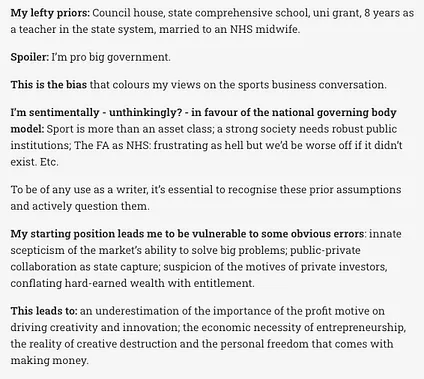
Which is a long way of saying that your views on The FA will likely shape your views on The FA Player: forward-looking test and learn experiment or a publicly funded white elephant?
Anything I write here is unlikely to change your mind.
But let’s use it to ask a couple of questions as to where we are in terms of rights holder strategy.
Life isn’t coding
Fail fast, test and learn, move fast break things blah blah.
Silicon Valley cliches have become sports biz bingo used by people with a commercial axe to grind against the status quo.
But life isn’t coding.
The recklessness of tech developers - see Grok’s latest calamity this week - just doesn’t fit with the big, slow bureaucracies who serve multiple constituencies and which live permanently in the public eye.
That said, failure is feedback - that’s another one - so if something fails, what did we learn?
Was it specific to The FA Player or was it market related?
Was it execution or strategy?
Is YouTube the one and only answer?
If yes, then what happens to the D2C argument, the oft-referenced walled garden of fans?
YouTube is flooding the zone
To click on Linkedin is to be swamped by pro-YouTube propaganda.
Every other post lays out over 400 AI generated words on why moving your sports content to YouTube is the smart guy move.
Jump to X and you quickly run in to an army of growth hack thread monkeys building the same case.
It all feels very orchestrated.
Almost as if these people are being paid, directly or indirectly, by the platform to shove old Joe Overton’s window a few yards their way.
See previous, from 2020: Sport’s Overton Window is on the move
Whatever. It’s working.
We can safely say that as of July 2025 sport is in The YouTube Era, in which the sports market throws its content at the channel, having been through it’s own ‘ build it and they’d better fucking come ’ era of OTT. See The FA Player above.
YouTube's fundamental offer - articulated by Tomos Grace at our EBU event in Bratislava - has not changed in 10 years: it provides reach and audience, allowing rights holders to take a clip of the ad revenue, but it typically does not pay large upfront checks or traditional rights fees.
Despite this, some in the sports industry cling to the belief that YouTube will change tack and join the risk-reward party.
Resisting idiotic binaries
Rights holders are left with the question as to where they put their content to best balance those age old adversaries: discoverability and revenue.
Some global sports acronyms are making high six-figure, low seven figure revenues from YouTube by understanding its role in their funnel and balancing it with their own subscription services.
Balanced against that money is the saving of cost and faff on the supply side. You upload to YouTube and go home.
Note George Pyne’s anecdote at the - I hear excellent - SportsPro investment event yesterday, where the Bruin boss recalled the aggro of Deltatre’s NFL Player launch. OTT is hard and if it goes wrong you get a tiny glimpse of what it must be like being the BBC - see Magnets of Hate, above.

Thinking in bubbles
So, the YouTube Era followed the OTT Era.
Another question nobody knows the answer to: is there a bubble beyond the YouTube Bubble?
Or is that it. The end of history?
Has the screen been won by YouTube and Netflix, and everything else is just nosies off?
Or is there, in the sports space at least, another go around; what might be called OTT 2.0, in which the upside of YT starts to feel like a shit deal and the big sports break for the border with their own, far better owned and operated service which joins the dots with merch, tickets and all the other shit sport sells to its users in a way that looks and feels like Amazon and TikTok.
This is what the money thinks will happen.
Why pile in cash without a thesis that goes beyond pennies on the pound via YouTube and a TV bundle that’s breaking up before our very eyes.
The Wonky Conclusion
Someone clever (Howard Marks to be precise) once said that being too early is indistinguishable from being wrong.
Is that the epitaph of The FA Player?
Nice idea, wrong time?
Does that theory stretch across the sports media landscape more generally?
That the first generation of OTT platforms just weren’t good enough. Too limited. Oversold.
The strategists jumped ten years too far ahead based on the wrong tech.
The idea remains viable.
But it ain’t gonna work on YouTube.
So, cue another tech building programme, more billions chasing the same notion of linking media consumption to fan data platforms, meaningful data lakes and merch and ticket tech stacks.
The LTV CAC wet dream hasn’t really happened yet. The mantra of understanding the fan, capturing first-party data to milk customer lifetime value remains an unattainable pipe dream for most sports bodies.
So, that’s the next pendulum swing, back to D2C and all that.
But there’s a wrinkle.
While sport might aim to be like Amazon or Tesco Clubcard.
Are we expecting Amazon and Tesco Clubcard to stand still?
Or, do they move further ahead, taking with them the customer’s expectations of what is frictionless digital service.
Let’s just agree to not think about that for a couple of years.