Skip to Content

Richard Gillis

54 posts

Posts by Richard Gillis

Idea dump

Idea dump
Photo by Daniele Franchi / Unsplash
  1. The tyranny of targets - how we've allowed quantifiable metrics to seep in to every aspect of our life, and the consequences of that. Source: The Score by C Thi Nguyen. Builds on Charles Goodhart of 'Goodhart rule' fame, that suggests metrics become corrupted when 'pressed in to service' as targets. The problem is not just that we contort our behaviour a bureaucratic incentive, it's that we cease to realise that we're contorting our behaviour at all. All metrics are reductive by design and the simplicity changes how we judge what matters and what can be cast aside. The outcome is that nuance and subtlety and personal values are abandoned in favour of what can be conveniently measured. There are four reasons this happens: portability, accessibility, interchangeability and co-ordination. Modern life, politics, science, tech, education...etc etc are dependent on these four variables, so are our love lives, sleep and exercise patterns and our view of what is good and bad. Each has a trade off. Usually the trade off is the swap of consistency and comparability with the loss of context. Decision making becomes more rigid, outliers are rejected, averages promoted. Netflixification: An ongoing example is the impact of Netflix on Korean cinema. The incentive to please the global entertainment market's gatekeeper has made Korean culture less interesting. The edges get smoothed. What worked before is tried again. The thing becomes a parody of itself. A caricature of Korean film is an average of what Netflix's algorithm deems 'a good show'. Supported by inarguable data. Gamification as prison: Games have rules and a score. The difference between games and life is that the goals are endlessly challenging and utterly unimportant. Games are fun because they are hard but can be played again. Rules as scaffolding for mastery. Gamified lives turn rules in to scaffolding for productivity, or a cage for poor players.
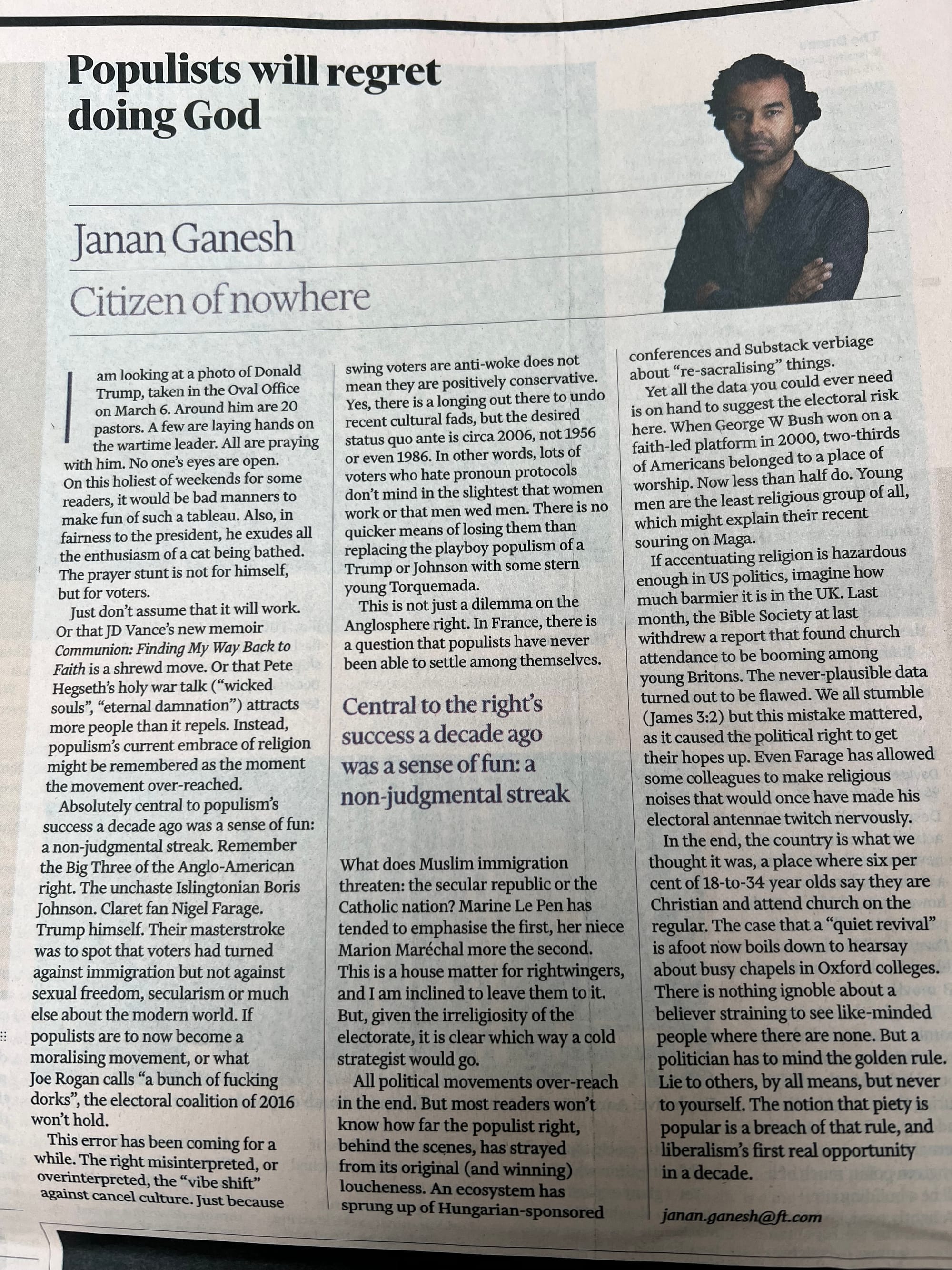
  2. It's hard to get rich doing something fun. From Janan Ganesh in FT. An explanation of the Epstein affair. There are two types of elite. The private 1% and the public 1%. Rich people want social status that comes with the arts, politics, journalism, the vibe. Intellectuals, politicians, actors etc want money they think should come with their social status. The traditional ways of making big money, banking, business, tech for example, are not intrinsically interesting. Some buy a football team or sponsor the arts to compensate. 'The public 1% are vulnerable to doing bad things for money, and the rich know it. Mandelson 'adored the public game but chafed at its penury'. Good line.
  3. Is the audience following or leading? Something I've been trying to articulate but not quite getting to the nub. I've had a few conversations recently about the assumption of the sports marketing industry that the product leads the audience: as in, you get your sports property on telly or YouTube or wherever, and the audience grows from there. Cricket and golf make me think something less obvious, or less linear, is happening. Golf is booming at grass roots level despite the shit show at the tour level, where the snafu between LIV and the PGA etc has bored golfers rigid. They are playing, club rates are soaring. Golf as TV product is a sideshow for those interested in that sort of thing. Cricket outside the formal economy is also an example, talked about in this week's podcast on the T20 World Cup. What has driven the audience for the game in Nepal, US, Netherlands etc? It isn't bilateral test cricket on television, which still pays for the 600million annual ICC revenue pool. You quickly get to a public v private frame, with governing bodies as government, and franchises as private money. The free market lobby will say that the associates have benefited from franchise leagues, which goes against the usual story of 'too much cricket confusing the audience' you tend to get from the governing bodies, who want to sell their thing. It's not binary. But it's also not linear.

Sent by Coventry

Almost a good headline.

The IOC boss throws her comms team under the bus. Tough day for James Pearce, the former BBC reporter who now heads up Olympic PR.

@dwnews

IOC President Kirsty Coventry has lashed out at her PR team during a press conference about not being properly informed about a series of controversial topics. Coventry expressed her frustration after being questioned about Gianni Infantino's involvement with Donald Trump's Board of Peace, Germany's reluctance to host the 2036 Olympic games and a New York Times story on Russian doping.

♬ Originalton - DW News - DW News

Questions arising:

The first bounce reaction, particularly from the sports PR industry, is that this was bad form, that it showed a lack of leadership, the sign of a weak president etc.

The counter is that she was right, that she should've been briefed and what is the PR team is paid for anyway?

You then get to a to-and-fro on the relative use of media training, which I've personally taken against after years of interviewing people who have been media trained. This can be bracketed with the general rise of PR as machiavelli, the elevation of a service provider to that of master strategist. 'PR at the top table', beware people bearing 'talking points' etc. If in doubt, blame Alastair Campbell, and Peter Mandelson, just to give this blog post the illusion of topicality.

🧵 OpenAI's ad pivot

You'll have seen the Anthropic Super Bowl ad.

I did a quick data scrape of this FT article.

Main bits:
'I would just disclose, as a personal bias, that I hate ads, they would be like a last resort for us as a business model. Advertising had its place as a way for the early internet to make money...'but i think they sort of somewhat fundamentally misalign a user's incentives with the company providing the service'

That was Sam Altman in 2024.

OpenAI has asked advertisers to commit an initial £200k in order to appear in ChatGPT results. The CPM is quoted around $60 per 1000 impressions.

Is this the creation of a whole new ad market? Comparisons are made with Netflix launching an ad-tier. The revenue from this was $1.5billion in 2025.

More than half of customers will find brands through AI generated summary by end of 2027.

Questions arising:

Is this enshittification in real time? Do ads in the chat undermine confidence in the results?

See 🤖 note on Enshittification here

Enshittification and Sports Media: A Cautionary AnalysisThe Strategic Bet

Sports rights holders increasingly view YouTube/Google as a growth engine for digital reach. The logic seems sound: massive built-in audience, sophisticated recommendation algorithms, global distribution, and revenue share from advertising. Free hosting for highlights. Live streaming infrastructure without capital expenditure.

Applying Doctorow's framework, this strategy deserves serious scrutiny.

Stage One: The Seduction

YouTube's initial offer to sports rights holders mirrors Facebook's pitch to publishers circa 2010:

"Come over to my platform... I know you're all using [traditional broadcast] but... we will never spy on you"

The platform offer is genuinely attractive:

  • Free distribution at global scale
  • Algorithmic amplification that surfaces your content to new audiences
  • Monetisation infrastructure without building your own ad sales team
  • Analytics and data on viewing behaviour
  • Lower friction than building direct-to-consumer products

Sports organisations pile in. They build subscriber bases. They train fans to expect content there. The audience grows.

The Lock-In Mechanism

Here's where Doctorow's collective action problem becomes critical for sports:

"You love your friends but like even the six people in your group chat can't agree on where you're going to go for a beer on Friday"

Translate this to sports fandom:

  • Fans follow their team's YouTube channel because that's where the highlights are
  • The team posts to YouTube because that's where the fans are
  • Fan communities form in comments sections and around YouTube content
  • Third-party creators build audiences reacting to and discussing official content
  • The algorithm learns what fans want and serves them more

The audience becomes YouTube's asset, not the rights holder's. The subscriber count, the watch history, the engagement data, the recommendation graph - all of this sits on Google's servers, governed by Google's terms.

Sports organisations face the same trap as publishers:

"Publishers meanwhile they found that they had to put more and more of their content on Facebook just to have it show up for the people who'd actually subscribe to their feeds"

Stage Two: Turning the Screws

Once dependency is established, the platform's incentives shift. Doctorow describes how Facebook treated publishers:

"You couldn't even have a link back to your own website because maybe that's a dangerous link right a deceptive link... eventually it's got to be the whole substitutive content no link back to your website"

For sports, the screws might look like:

Algorithm manipulation: Your content's reach becomes a function of how well it serves YouTube's goals, not yours. Doctorow cites Amazon's search manipulation:

"The top result on an Amazon search results page is there because they paid more than everyone else it's not because it's the best match for your search"

YouTube already operates this way. Reach is increasingly pay-to-play. Organic distribution declines. You must buy ads on the platform to reach the audience you built on the platform.

Revenue share erosion: The 55/45 split that seemed generous becomes 50/50, then 45/55. Ad rates fluctuate based on Google's priorities, not yours. Doctorow notes:

"Advertising prices go way up advertising fidelity goes through the floor advertising ad fraud explodes"

Direct competition: YouTube has already bought NFL Sunday Ticket and MLS rights. The platform that was your distribution partner is now your competitor for the same inventory. They have perfect information about what your content is worth because they've been measuring it for years.

The Monopsony Problem

This is perhaps the most under-appreciated risk. Doctorow explains:

"A 20% share as a monopsinist is basically dispositive it gives you total control 20% share as a monopolist is just an inconvenience for your customers"

If YouTube becomes where a significant portion of sports fans consume digital content, the power dynamic inverts completely. Rights holders must be on YouTube to reach fans. YouTube knows this. Every negotiation happens with that leverage.

The sports parallel to Doctorow's coffee shop analogy:

"Imagine you know there's a block with like five coffee shops on it... that coffee shop has an office building next door like this one and 20% of their gross receipts come from the people in the office building and one day that business goes under... the coffee shop is probably out of business"

What happens when YouTube changes its algorithm and your highlights reach drops 40%? What happens when they decide live sports should be behind YouTube Premium? What happens when they renegotiate revenue share?

You're the coffee shop. They're the office building.

The Economy-Wide Tax

Doctorow describes how Amazon's practices raise prices everywhere:

"Because of most favored nation they have to raise prices at Target at Walmart at the factory store and at your local convenience store so this is an economywide tax"

In sports media, the equivalent might be:

  • If YouTube's ad rates set the benchmark for digital sports content value, they set it for everyone
  • If fans are trained to expect free content on YouTube, they resist paying elsewhere
  • If YouTube's recommendation engine determines what content gets made (because that's what gets views), editorial independence erodes
  • If YouTube takes a significant cut of digital revenue, that cost gets passed through the entire sports media ecosystem

What History Tells Us

Doctorow is explicit about what happened to publishers who followed this path:

"This is what destroyed the media industry"

The pattern was:

  1. Free distribution and traffic seemed like a gift
  2. Publishers became dependent on platform reach
  3. Platforms changed the rules (pivot to video, algorithm shifts, news feed changes)
  4. Publishers who had hollowed out their direct distribution capabilities had no fallback
  5. Value flowed to platforms, publishers collapsed

The ad fraud revelation is particularly stark:

"Proctor and Gamble in 2017 they zeroed out their annual $200 million spend on programmatic advertising surveillance advertising they saw a zero drop in sales that is such a wild stat it's like to a first approximation no one saw the ads it just disappeared down the fraud hole"

If P&G's $200 million in digital advertising produced zero measurable effect, what confidence should sports rights holders have that their YouTube strategy is building real, transferable value?

The Counter-Arguments (And Why They May Be Wrong)

Sports rights holders might argue they're different:

"Live sports is appointment viewing, not disposable news"

But the valuable content being given to YouTube isn't live rights - it's highlights, behind-the-scenes, shoulder programming. This is precisely the content that trains fans where to find your brand. And increasingly, live rights are going to platforms too.

"We have contractual protections"

Publishers had contracts too. Contracts expire. Leverage shifts. And contracts don't protect against algorithm changes, revenue share adjustments within agreed ranges, or the platform deciding to compete directly for your rights.

"Our brand loyalty is stronger than news publishers"

This may be true for the core fan. But the growth audience - the casual viewer, the new market, the next generation - their loyalty is to convenience. If they learned to find you on YouTube, that's where they'll look. You didn't build loyalty to your brand; you built loyalty to the platform experience.

"We need to be where the audience is"

This was Facebook's pitch to publishers verbatim. Doctorow's response:

"It's just not you're not going to shop your way out of a monopoly right that's like saying you're going to like recycle your way out of the wildfires"

The Brittle Equilibrium

Perhaps most troubling is the instability of the current arrangement. Doctorow describes the precariousness:

"The difference between god I hate Facebook but I can't seem to stop logging into it and god I hate Facebook I'm never going back again it's very thin"

YouTube's dominant position in digital video isn't guaranteed. Regulatory action, a competitor (TikTok before bans, whoever comes next), a scandal, or simply a strategic pivot by Google could reshape the landscape overnight.

If that happens, what do sports rights holders own?

  • Not the subscriber relationships (those are YouTube accounts)
  • Not the viewing data (that's on Google's servers)
  • Not the recommendation graph (that's YouTube's algorithm)
  • Not the payment relationships (that's YouTube Premium, YouTube TV)

You own the rights. But you've trained a generation of fans to consume those rights through infrastructure you don't control, can't influence, and could lose access to.

What Would Doctorow Advise?

Based on his framework, the answer is about adversarial interoperability and owning your relationship with the audience:

"Why is Facebook in charge of what you see when you look at Facebook"

Translated to sports: Why is YouTube in charge of what fans see when they look for your content?

The strategic imperative would be:

  1. Build direct-to-consumer infrastructure even if it's smaller than platform reach
  2. Capture first-party data on every fan interaction possible
  3. Use platforms for acquisition, not retention - get fans onto owned channels
  4. Diversify platform presence so no single platform has monopsony power
  5. Retain premium content for owned distribution, give platforms only what drives traffic elsewhere
  6. Negotiate data rights as aggressively as revenue share

The question for sports executives is whether the short-term reach gains from YouTube are worth the long-term strategic dependency.

Conclusion

Doctorow's enshittification framework suggests that giving valuable sports content to YouTube is not a growth strategy - it's a value transfer strategy. The growth accrues to the platform. The lock-in traps the rights holder. The extraction phase hasn't arrived yet, but the infrastructure for it is being built with every subscriber gained, every highlight posted, every fan trained to expect content there.

"These are like the foreseeable and foreseen outcomes of specific policy choices made in living memory by named individuals who were warned at the time that this would happen"

Sports executives making platform distribution decisions today are those named individuals. The question is whether they're listening to the warning.

The counter argument - 'Ads are why we have nice things'

Yeah but.

🤖 Summary of the Andressen Horowitz position

The Pro-Advertising Argument for ChatGPT

Source Context

This article is from a16z (Andreessen Horowitz), a major investor in OpenAI. The conflict of interest is material: a16z needs OpenAI to find sustainable monetisation to justify their investment and generate returns. The article should be read with this lens.

Key Arguments Summarised.

  1. Ads as Public Good

The central framing positions advertising as democratising rather than extractive:

"Ads are why we have nice things... the internet has always run on ads and most people like it that way."

The argument: charging subscriptions limits access to those who can afford $20-200/month. Ads enable universal access.

2. The "Luxury Beliefs" Dismissal

Critics of advertising are characterised as performative rather than principled:

"For all the moralistic hand-wringing over 'Selling data!' or 'Tracking!' or 'Attention harvesting' and other bingo words... People who pretend this is a bad thing usually are trying to prove something to you."

This rhetorical move attempts to delegitimise structural criticism as mere status signalling.

3. The Long Tail Problem

The core business case: most users won't pay because most use cases don't justify payment.

"Most people use AI for personal productivity: things like writing emails, searching for information, and tutoring or advice. Meanwhile, higher value pursuits, like programming, make up a very small percentage of overall queries."

The data cited: 5-10% of 800M weekly active users convert to paid (40-80M people). But to reach "a billion people and beyond" requires an alternative to subscriptions.

4. Users "Actually Like" Targeted Ads

"Ask the average Instagram user, and they'll probably tell you that the ads they get are ridiculously useful: they get served products they actually want and need, and make purchases that actually make their lives better."

5. Historical Inevitability

The article frames advertising as the natural endpoint of all consumer internet products:

"Any internet history buff knows that ads are a core part of how platforms eventually monetize: Google, Facebook, Instagram, and TikTok all started free, and then figured out monetization with targeted ads."

For giggles, I put the A16Z rationale through Claude (see Super Bowl ad above...), and asked it to critique the pro-advertising arguments through the lens of enshittification.

🤖 Critique: Is This Enshittification?

Applying Doctorow's framework to the a16z argument reveals a textbook case of enshittification logic - the article essentially describes the transition from Stage One to Stage Two while framing it as benevolent.

The Three Stages Applied

Stage One (Complete): Attract Users

OpenAI offered a genuinely remarkable product for free. ChatGPT's initial launch was subsidised by investor capital, offering capabilities that felt magical. Users arrived in hundreds of millions.

Stage Two (In Progress): Lock Users In

The lock-in mechanisms are now firmly established:

  • Memory: ChatGPT remembers your preferences, past conversations, context about your life
  • Workflow integration: Users have built habits, processes, and expectations around the tool
  • Skill atrophy: Users who rely on ChatGPT for writing, research, or coding have reduced those muscles
  • Switching costs: Moving to Claude, Gemini, or Llama means losing conversation history, retraining preferences, rebuilding context

The a16z article implicitly acknowledges this lock-in when discussing the 800M WAU base as an asset to be monetised.

Stage Three (Announced): Extract Value

The article is explicitly a roadmap for value extraction:

"If you want to get ChatGPT to a billion people (and beyond) for free you need to introduce a product other than subscriptions."

Translation: the current user base will now be monetised through advertising, regardless of whether this serves user interests.

Deconstructing the Article's Claims

Claim: "Ads are why we have nice things"

Doctorow's counter:

"This is what destroyed the media industry"

The publishing industry also believed platform advertising would fund quality content at scale. Instead, it transferred value to platforms while hollowing out the publishers who created content.

Claim: Critics have "luxury beliefs"

This is a rhetorical dismissal that avoids engaging with structural criticism. Doctorow addresses this directly:

"It's just not you're not going to shop your way out of a monopoly right that's like saying you're going to like recycle your way out of the wildfires"

The criticism of advertising isn't aesthetic preference - it's about power dynamics and value extraction.

Claim: "People actually like ads"

The article cites Instagram as evidence. But Doctorow would note the selection bias: people who hated the ads left. Those who remain are either tolerating them or have been successfully habituated. User satisfaction surveys of captive populations don't measure the counterfactual.

More critically, the P&G revelation:

"Proctor and Gamble in 2017 they zeroed out their annual $200 million spend on programmatic advertising surveillance advertising they saw a zero drop in sales"

If $200M in targeted advertising produced no measurable effect, the "people like useful ads" claim deserves scrutiny.

Claim: This is historical inevitability

"Any internet history buff knows that ads are a core part of how platforms eventually monetize"

This frames a policy choice as natural law. Doctorow's response:

"These are like the foreseeable and foreseen outcomes of specific policy choices made in living memory by named individuals who were warned at the time that this would happen"

Google and Facebook chose advertising. They could have chosen other models. The outcomes - surveillance capitalism, attention harvesting, algorithmic manipulation - were not inevitable but designed.

The Conflict of Interest Problem

The article never discloses that a16z is an OpenAI investor, though this is widely known. The entire argument serves a16z's financial interests:

  1. OpenAI needs to monetise to justify its $150B+ valuation
  2. Subscriptions have plateaued at 5-10% conversion
  3. Advertising unlocks the remaining 90%+ of users as revenue sources
  4. Higher revenue justifies higher valuation
  5. a16z's investment returns depend on this

When Doctorow describes how platforms "drain the value off of them to harvest it all for the shareholders and the executives," this article is the shareholders explaining why draining value is actually good for everyone.

What the Article Admits

Perhaps most tellingly, the article concedes several points that undermine its own thesis:

Admission 1: Most queries are low-value

"Why would they pay for an answer to questions like 'why is the sky blue'... when previously a Google search would direct you to a good-enough answer for free"

If most AI queries are Google-substitutes, and Google already has advertising, what's the differentiated value? The admission suggests ChatGPT's advantage may be temporary convenience rather than structural superiority.

Admission 2: Power users don't want ads

"Programmers are some of the most committed users of LLMs, with some even calibrating their sleep schedules to optimize for daily usage limits. For these users, a $20 or $200/month subscription doesn't feel exorbitant"

The most valuable users - the ones who generate the most engagement, provide the most training signal, and demonstrate the most transformative use cases - are precisely the ones who will pay to avoid ads. Advertising optimises for the long tail of casual users while potentially degrading the experience for power users.

Admission 3: The ad experience problem is unsolved

"Can you transpose a more 'lean-back' ad experience on Instagram or TikTok into the more engagement-heavy model of using ChatGPT? It's a much harder problem"

The article acknowledges that conversational AI advertising is fundamentally different from feed-based advertising, without a proven model for doing it well.

🤖 Unofficial Briefing Note: Barney Francis

🤖 These notes are AI generated (What does this mean?).

Podcast: Unofficial Partner Guest: Barney Francis, IMG (formerly Head of Sky Sports)


Summary

Barney Francis offers an insider's view of the sports media economy, drawing on his experience running Sky Sports and now leading IMG's production business. The conversation spans new sports formats, piracy, streaming disruption, rights economics, the creation of The Hundred, the Premier League's move to in-house production, and the structural challenges facing rugby in the UK. A consistent thread throughout: the consumer should be at the heart of every decision, and the fundamentals of premium live sport have only strengthened since COVID.


Key Themes

1. New Formats Are Additive, Not Disruptive

Francis frames Baller League, TGL, and similar ventures as supplementary to established sports rather than existential threats. He stresses the importance of managing expectations around these properties and warns against overreading individual case studies.

"Their ambition would never have been, let's stop people watching the tours. It's just, here's something that's additive, that's fun."
"Individual case studies don't necessarily [prove] the story is wrong or the story is flawed."

He notes TGL's narrow scheduling window — filling the January gap before the major golf tours ramp up — as evidence of its complementary positioning.

2. Resilience of Incumbent Rights Holders

A central argument: since COVID, traditional leagues and formats have experienced a sustained commercial boost. The big events still command the largest audiences and the most intense engagement.

"Since COVID, live sport and fundamental, the heartland of live sport that we all know and love is what's really, really, really delivered."

He cites the Super Bowl's 127 million households, the enduring pull of the Ashes over IPL in UK audiences, and the Premier League's continued international growth as evidence.

3. Piracy: From Nudge and Wink to Cultural Norm

Francis describes a generational shift in attitudes to piracy that represents an existential threat to the pay-TV sports model. What was once marginal behaviour has become normalised among younger audiences.

"The nudge in the wink 15 years ago is now for the next generation a cultural norm."
"A new generation and therefore the generations that follow who don't expect to pay for anything."

He recounts conversations with his university-age son's friends who uniformly plan to consume sport via fire sticks and illegal streams once they enter employment — not as a temporary workaround but as a default.

4. The Netflix Value Equation

Francis argues Netflix's low price point and superior user experience effectively immunise it from piracy. This frames the broader challenge for premium sports subscriptions.

"People don't mind parting with 15 pounds a month versus say, a hundred pounds a month."
"There's a brand halo with Netflix. It feels like value."

He tracks Netflix's evolving sports strategy — event-driven rather than league-based (NFL Christmas Day, boxing, WWE Raw) — as a distinctive model that doesn't yet threaten the core rights market.

5. Rights Fragmentation vs. Consolidation

The tension between maximising revenue through multiple buyers and creating a coherent consumer experience runs through several examples. Francis contrasts the Six Nations (all on ITV, clear destination) with the NWSL (spread across five broadcasters) and rugby union in the UK (widely fragmented).

"Right now I think rugby is spread quite far and wide in this UK."
"Ultimately the heart of the sports economy is the consumer."

He references his breakfast with NWSL Commissioner Jessica Berman, who is actively weighing whether consolidation or distribution better serves the league's future.

6. The "Home of" Strategy

Francis treats "home of" positioning as more than marketing — it requires critical mass of rights to be credible. He uses Sky's golf portfolio (both tours, all four majors, Ryder Cup) as the benchmark.

"If you and I were to start off a startup broadcast network today... we might be able to buy the Estonian League in the UK and therefore we could call ourselves the home of football in the UK for the Estonian League."

7. Sky's Consumer-First Philosophy

Francis articulates a rigorous commercial logic at Sky: every rights acquisition had to be justified by subscriber value. Personal taste was irrelevant.

"I'm just a custodian for Richard's money, and my job is to spend it as wisely as possible."
"If I made decisions for me and my interests, I'd have Aston Villa at four o'clock every Sunday."

8. Rugby's Structural Failures

Francis reveals that Sky did not walk away from rugby — the sport's own decision-making prevented the creation of a dedicated rugby channel. He points to deeper structural issues: governance fragmented across too many bodies, a sport played in only 5% of schools, and administrators who were too subjectively invested.

"The reason they weren't on Sky was not lack of appetite for Sky. It was decision making their end for whatever reason. And those reasons weren't always commercial."
"If you're only pooling from 5% of the population every year, that sort of trickles over."

He questions whether CVC has sufficient leverage to aggregate rugby's fractured landscape.

9. The Creation of The Hundred

Francis gives a first-hand account of the moment Tom Harrison pitched The Hundred, framing it as a participation bridge between junior cricket and professional formats — a problem T20 had originally solved but subsequently lost its way on.

"Instantly I said to him, right, it's red versus blue... you start on naught and you've got a hundred balls. As one goes up, the other comes down. Let's make it really, really simple."

He connects this to Sky's long-standing philosophy that rights investment must be paired with grassroots participation programmes.

"Without young people coming through, without the sport being played at grassroots, then we are just playing around until the sport ends."

10. Premier League Production In-House

Francis explains the Premier League's decision to bring production in-house as driven by the need to own relationships with overseas licensees now that international revenue exceeds domestic.

"They want to be closer to understanding what their Japanese licensee wants, what their New Zealand licensee wants."

He positions this as exceptional rather than a new industry norm — very few leagues have the scale and revenue to absorb the cost and operational risk.

11. Remote Production and Efficiency

IMG is increasingly remote-producing matches (e.g., directing a Vancouver MLS game from Stockley Park via fibre). Francis describes eliminating links in the production chain while maintaining or improving quality.

"From the pitch to the eyeball, there are so many links in the chain. Every link is a cost."

He acknowledges the perception issue — audiences can feel a broadcaster isn't taking a sport seriously when commentary is remote — but notes it varies by sport.


Potential Follow-Up Lines

  • Francis hints at non-commercial reasons behind rugby's decisions regarding Sky — a story he explicitly declines to tell ("We've only just met each other"). Worth revisiting.
  • The Hundred's 2028 ECB renewal: Francis acknowledges new franchise owners will push for maximum value but insists the market sets the price. Tension between Sky's founding role and competitive bidding.
  • CVC's ability (or inability) to unify rugby governance — Francis is sceptical but stops short of a definitive view.
  • Athletics: Francis expresses genuine dismay at the state of the sport, calling it the most inclusive participation opportunity available. Could be a standalone conversation.

Context for Archive

Cross-references well with previous episodes on: county cricket economics, the bundling debate (Murray/Yannick), Bill Bush on piracy, Premier League international rights strategy. Francis's consumer-first framing and grassroots emphasis provide a strong counterpoint to guests who lead with disruption narratives.

🧵Super Bowl thread

  1. 11 minutes of game time, three hours of ads.
  1. Half time as culture war
“From the War Department, we salute Turning Point USA and everyone who believes freedom is still worth the fight,” Hegseth said in the video. “Thank you for your courage as an organization, your clarity and leadership, and for this halftime show the war department is proud to support.”
While Turning Point USA drew over 6 million concurrent views on YouTube, the television audience for the Bad Bunny halftime show was expected to be much larger. Last year, Kendrick Lamar’s halftime concert drew 133.5 million views, the most for any Super Bowl halftime show.