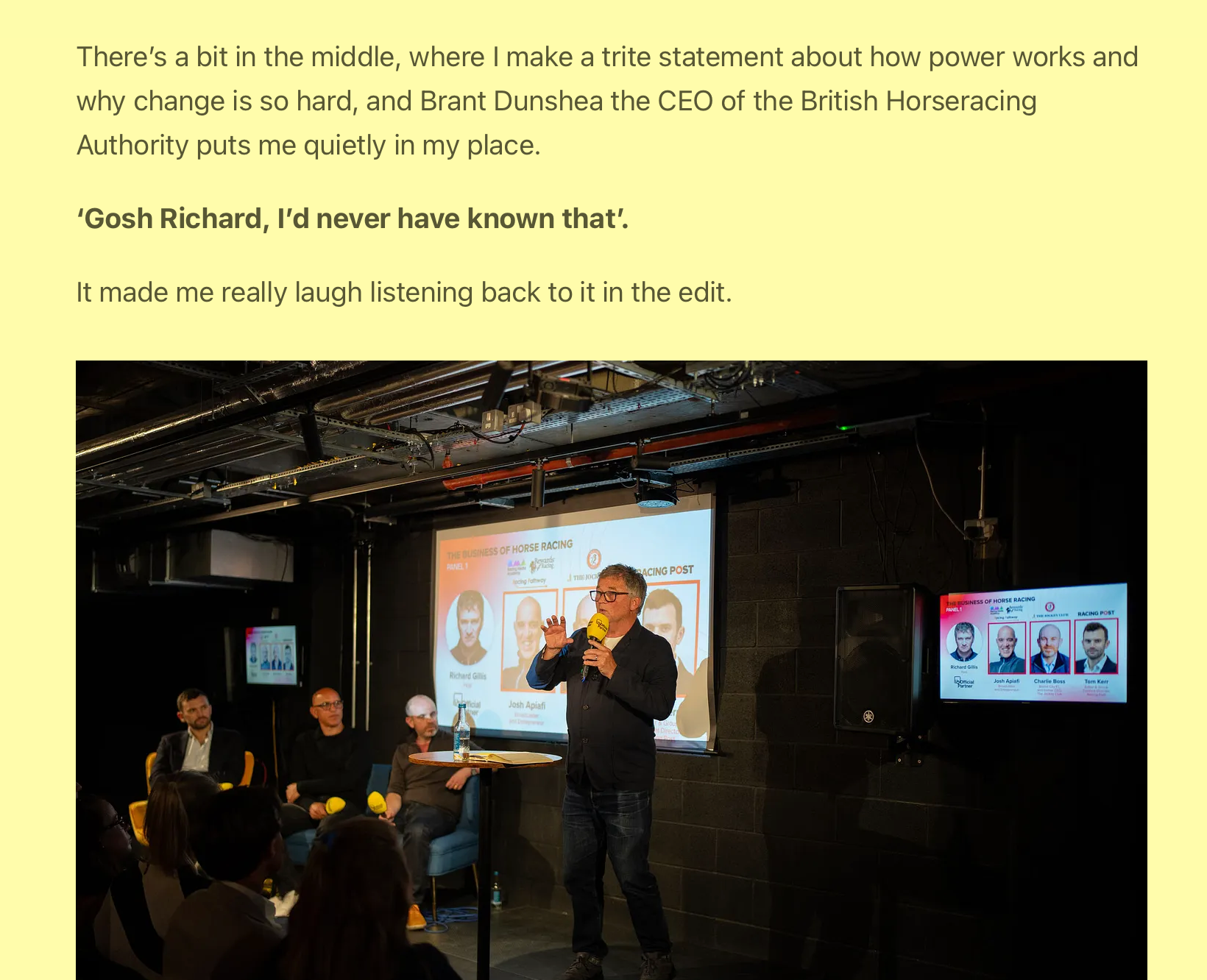
Alex Cottee sent me this. It's basically what we talked about for our business of horse racing (horse racing, horseracing, horse-racing?) night at the Big Belly Club last month.
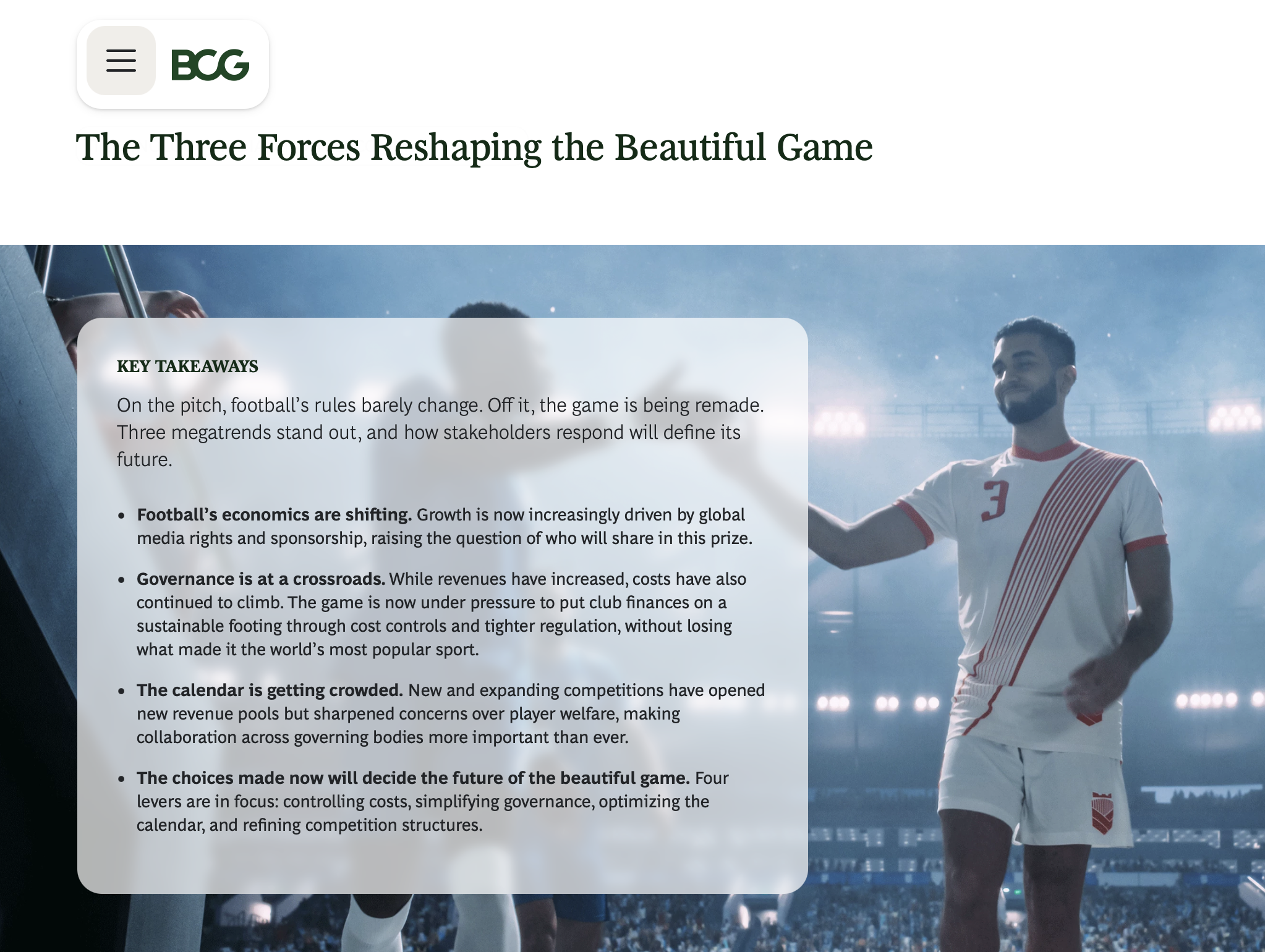
It slavishly follows the McKinsey for Sport playbook. Makes sense in abstract, it's just real life seems to get in the way of many of these projects. Sports in general, and horse racing in particular are odd shaped things, the resistance to the new is profound and baked in. Getting the constituencies to align is the problem. As mentioned to Brant Dunshea on the night:
Spent much of last week in corporate hospitality. Wimbledon, twice and The Oval. Whisper, IMG and the ECB were the hosts. On Monday I was walked out of Centre Court with Sunil Patel, and we bumped in to Neil Chugani, who I didn't know, but have found out has one of the standout CVs in sport. Friday was spent gossiping in the IMG hospitality lounge. Chatted with Adam Kelly about our recent podcast. We'd recorded it a few days earlier and he thought I'd been grumpy, which is code for asking some uncomfortable questions. The truth is I did want to push Adam a bit. There are two stories about IMG, the one they want to tell and the one their competitors want to tell. Neither is the truth, but listening to a CEO doing talking points is dull af. He got it, and enjoyed the to and fro. And the podcast is better as a result.
>>The Oval Got stuck in a lift with Blaze and Tonk, which is the memoir title sorted.
White wine (me) with Juliet Slot, Beth Barrett Wild and Kate Hannon. The game got tense. Nat Sciver Brunt played brilliantly to get England in to the final, to everyone's relief, apart from the South Africans obvs. Beth B-W exits ECB on a massive high. Walking back to Vauxhall tube, two blokes in Lauren Bell merch.
Just to be clear, the following copy is taken from a BBC Sport news story, not an Adidas press release:
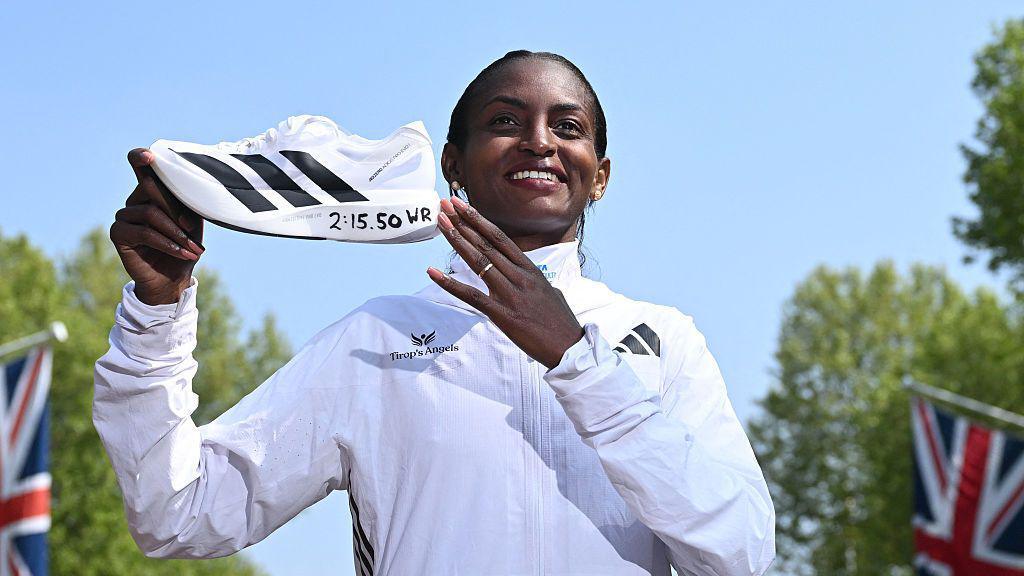
What shoe did Sawe, Kejelcha and Assefa wear? All three athletes wore Adidas' Adizero Adios Pro Evo 3. The shoe was launched on 25 April, just two days before the world's best took to the streets of London.
It is the third iteration of a hugely popular shoe. Adidas worked with Sawe, Kejelcha and Assefa over the last three years to produce this version of the trainer.
In Sawe's case, it helped him break Kiptum's London course record of 2:01:25 by nearly two minutes. Sawe thanked Adidas for making what he said were best shoes he had worn, particularly highlighting how "very light" and stable they are.
Image caption,
What makes the Pro Evo 3 different? At 99 grams, the trainer is the first 'super shoe' to weigh under 100g. That's lighter than a medium-sized apple, a banana or a bar of soap. In recent years, major improvements in marathon times have been made thanks to the introduction of carbon-plated midsoles. But the Pro Evo 3 instead uses carbon technology - rather than a plate - that wraps around the midsole, helping to maintain running economy and to reduce overall weight.
"At that level, every detail really matters - we were measuring things down to the nearest nanogram," Adidas' VP of running, Patrick Nava, said of the design process. "It was a long process, but it's led to something we believe genuinely changes what a race-day shoe can feel like." For the casual runner taking advantage of the technology comes at a financial cost though. While a limited amount were available this week, a wider release is expected later this year when the shoes will retail at £450.
Enter a liberal's pro-BBC caveat: The BBC is the key broadcast rights holder of the London Marathon, and it's fantastic at it. A wonderful celebration of humanity that fits perfectly with the national broadcaster.
But it is the wrong time to do a deep dive on Adidas shoes that won the race and broke the two-minute record, the two-hour marathon record.
BBC news shouldn't be a cheerleader, it should be a news outlet.
When in doubt, blame the Americans
See previous post: What's the difference between ESPN and the NFL?
The Times understands that it was mainly the result of people overseas who were trying to claim the financial incentive offered for completing surveys; it found that the fraud was human, rather than being caused by automated bots.
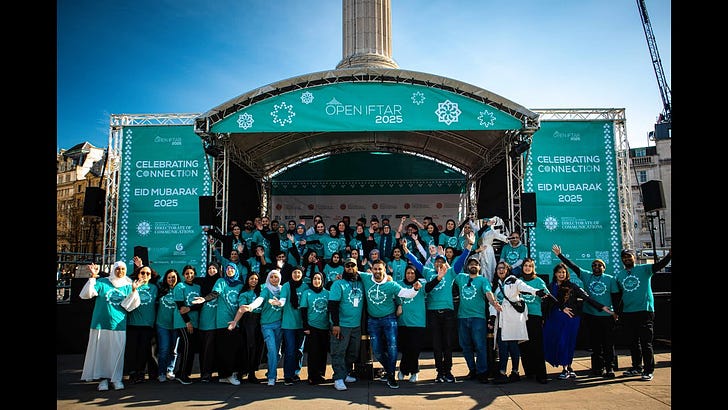
See also: excellent piece on the right's islamophobia.
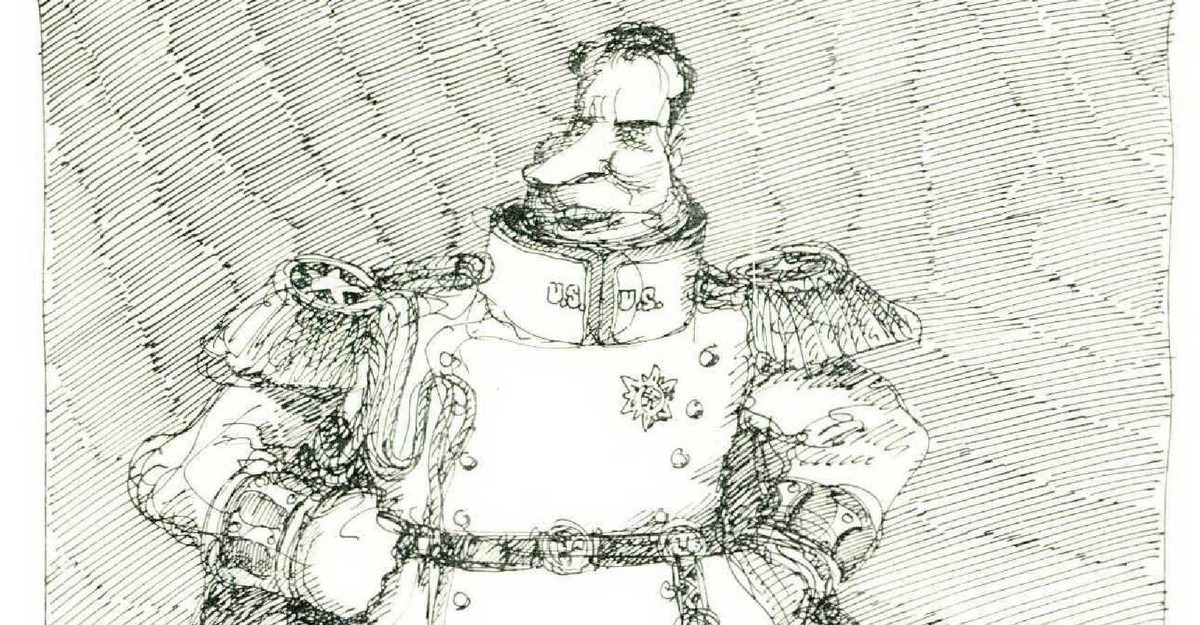
Roth defined satire as "moral outrage transformed into comic art" and "a verbal ritualization of frustration and anger".
Malcolm Gladwell's Revisionist History is really good on the paradox of satire, which includes a version of confirmation bias, when viewers interpret satire in a way that aligns with their pre-existing beliefs.
A famous example is The Colbert Report, a right wing parody beloved by conservatives.