I enjoy talking with old pros. In this case defined as people who've worked in the industry for a long time.
Some of them have great stories; eye opening, jaw dropping anecdotes from their careers spent in and around the room where it happened.
My response is obvious: Come on the podcast and tell them.
Or, write them down. Publish them in a book, or a Substack.
Most don't want to do this.
They're worried about damaging their own or other people's reputations. Or they want a job and worry that they'll be seen as telling tales out of school. Sometimes it's just vanity stopping them, the stories aren't as interesting as they think, or they're not true.
But at what point do you say fuck it. I'm going to tell my story. As truthfully as I can. I've come to think that maybe our only job is to record as faithfully as we can what it was like to live at this time and in this place.
So, what are you waiting for?
The second question is can you be honest about the role you played.
Are you the main character, or a support act.
Are you Hamlet or Guildenstern?
Both are important.
But you need to be honest, and this can be added to the fears listed above, because the truth might conflict with how you've presented yourself in the past. We all big ourselves up, positioned ourselves closer to power than we really were, a little higher up the pole that was really the case.
The vast majority of us are Guildenstern. A minor character in a bigger story.
the Stanford study, a survey of more than 8,000 Liverpool fans, suggested the reason for the reduction in prejudice towards Muslims in Merseyside was because Salah was familiarizing his fans with Islam, through his observation of the faith, while his image as a bubbly father, friend, and fantastic footballer breaking down stereotypes of “threatening Muslims”.
We did a podcast on PR. Called it Spin Class, which the participants didn't much like. They don't like the word spin, they prefer reputation, which sounds more grown up, and certainly more expensive.
Hear it here:
The Kirsty Coventry press conference, as we can now call it, was a big bit of the conversation. Jon Tibbs was in the room when it happened and reported back. Context is useful on these occasions. The summary would be that this was a blip at the end of what has been deemed a successful Winter Olympics.
See my previous note, written at the time, was a wearying counter to the PR Week meets Linkedin response, that this was a dereliction of duty from such a senior leader, won't anyone think of the comms department...etc etc.
A few things from the podcast that I'd like to capture here.
That press conference was not a PR crisis, but it is interesting. I'm generally hugely in favour of people saying what they mean when standing in front of a microphone. See also Sir Jim Ratcliffe's 'Colonised by immigrants' statement to Sky. I don't agree with him but it's really important that we know that's how he thinks. My esteemed podcast guests are among the best in the industry and I like and respect each one of them. But their job is to stop this sort of thing from happening. Keep Sir Jim away from a mic. Coventry should have done the bollocking in private. I disagree.
How will Kirsty Coventry deal with Donald Trump? This is the biggest challenge in sports leadership today. The LA28 Olympics is a politically charged moment in the American political calendar: a global platform in Gavin Newsom's home state during election year. Part of the architecture of this from a PR point of view is the dreaded Oval Room meeting cum press conference. But it's far more than PR, it's about what the IOC stands for, and whether Kirsty Coventry can not just defend it, but sell it. It will be the work of a morning for Stephen Miller to frame Olympism as a festival of liberal woke cuckdom. Gianni Infantino didn't have this challenge. FIFA doesn't stand for much, giving him license to wear the red MAGA cap and create a peace prize. FIFA's reputation isn't as valuable.
Bach's shadow. Jon Tibbs said that Coventry was a tough cookie and 'her own person'. I'm pleased to hear that. I've a feeling that the election process did her few favours in this respect, seemingly stage managed by her predecessor to allow his own agenda to continue, led by his 'chosen candidate'.
This podcast has been one of our best performing. Not a surprise, Simon Denyer is one of the smartest guys in the room.
Part of the conversation was about betting.
A question I've asked a few times on the podcast is about where betting sits in the private equity playbook.
I was struck by how bullish George Pyne was on TGL, and how explictly he referenced it as a potential betting product.
The p/e money likes betting for semi-obvious reasons to do with risk diversification and revenue predictability.
As Denyer notes, when evaluating sports investments, "a sport that has a second or third main revenue stream is really interesting compared to a sport that relies on TV for 90% of the money... you've got a material second revenue stream, and sometimes it's actually bigger than sponsorship."
There's a strong link between betting and other forms of fan engagement.
Sports that generate betting interest typically indicate passionate fan bases willing to spend money on that interest, which can translate across multiple revenue streams - merchandise, ticketing, premium content subscriptions blah blah blah.
This diversification appeal operates on multiple levels: Television rights face cyclical pressures from broadcaster consolidation, cord-cutting, and economic downturns. Betting revenue operates on different market dynamics - it's driven by fan engagement rather than media company budgets.
When Sky reduces sports rights spending, betting turnover on those same matches may actually increase as fans seek alternative engagement methods. Unlike broadcast rights that face intense bidding wars and regulatory intervention, betting data deals offer more stable, long-term revenue with predictable margin structures.
The "official data feed" model creates natural monopolies that resist competitive pricing pressure. A sport with strong betting appeal can monetize audiences in markets where broadcast rights generate minimal value, lending a bit of oomph to a rights holder's international strategy. Given this is how the investors think, there's an obvious incentive for individual rights holders to make their sport more 'betting friendly', to take advantage of the arguments laid out above. (We'll park the shouldquestions for a moment).
>>What if…<<
Just for sake of provocation, what would happen if we took a major women's soccer league and pointed it toward this question.
Traditional broadcast rights remain limited outside major tournaments, sponsorship deals lag behind men's equivalents, and attendance revenue varies dramatically by market. Unlike men's football where betting represents supplementary income, for women's leagues it could become a primary revenue driver during the growth phase.
Adding meaningful betting revenue could provide the financial foundation for league sustainability and player compensation improvements.
Women's football generates substantial in-play betting interest during major tournaments - the World Cup and Euros see significant betting volumes. But this engagement doesn't translate to regular league matches because betting operators lack comprehensive data feeds and league betting markets remain underdeveloped. Creating systematic betting data partnerships could establish year-round revenue streams independent of broadcast deal negotiations.
But.
You run in to the c word. Culture.
The (or, A) current trajectory of women's football is as a purpose-led family-friendly product - an alternative to the 'over-commercialised' excess of men's elite football.
Betting runs against that narrative.
Simon Denyer's analysis reveals the fundamental limitation: "It is very, very easy to create a new product... very different to completely changing behavior." 20% of sports fans bet. "That 20% who bet do so primarily on sports they already follow intensively".
The sports that successfully leverage betting revenue - tennis, golf, men's football - had established passionate followings before betting integration. They didn't use betting to create fan interest; they monetized existing interest through betting channels. Chicken, egg.
The other problem is data, or the lack of it.
"You look at how much revenue is being turned over on Serie A Football in Italy... then you go, well, how much of that is in-play? Right. And you'd be amazed. It's like sometimes it's 90%... If 90% of it's in-play... these are all things that require data, and these are all things that are enhanced by having the live video stream."
So the betting angle presents both opportunity and trap. The diversified revenue argument appears compelling, but depends on achieving sufficient scale to generate meaningful betting turnover. This requires substantial upfront investment in data infrastructure, marketing, and content creation without guaranteed returns. The timeline mismatch creates additional complexity. PE investment horizons typically span 5-7 years, but building betting-friendly sports requires behavioral change that operates on longer timescales. The revenue diversification benefits may not materialise within typical investment windows.
More fundamentally, optimizing women's football for betting appeal could undermine rather than enhance the current model, conflicting with broadcast appeal, attendance growth, or youth participation. These competing priorities could fragment development efforts and reduce overall investment effectiveness.
Denyer quotes:
Why the Betting-Broadcasting Convergence Dream Died:
"I don't necessarily agree with convergence of betting and sports broadcasting... there's been one good example of it, which was Sky owning SkyBet. They did a brilliant job of driving subscribers to SkyBet... But I don't think there's been many, many more, and I don't think it's really critical.
The Living Room vs Mobile Reality Check:
"My viewing experience, like most people's now is connected TV, right? I want the best viewing experience for my live sport. So that's on a connected TV. That is not a great place to stick a betting app or betting functionality. It's really clunky... you're suddenly trying to do an accumulator with five different bets whilst on your remote control. It's just not gonna happen.
Betting boosts advertising revenue but don't bet the house on it
"Although it may appear to you to be quite a large piece of the inventory, as a viewer, it's still a relatively small part of the revenue... you are talking maximum 10% from advertising overall. And let's say betting is 30% of that max... So it's kind of from zero to 3% of the overall mix. So it's not as big as you realize."
Wang’s book tackles this lament, which runs through the political conversation from pot holes to HS2.
The lawyer vs engineer framing (Warning, contains nuance).
Blaming lawyers for blocking progress is a trick beloved of populists the world over. They do it because it works. Lawyers are unpopular, until you need one on your side.
So, let’s be careful with the lawyer-engineer binary; I admire China’s bridges but don’t want to live there etc.
The flip of the CCP’s engineering mindset is a chilling disregard for personal liberty, a tendency to social control, treating citizens as raw material to be shaped by policies like one-child and zero-COVID. The results are cataclysmic if you live in the way of the next train line.
With that caveat…Wang characterises the US (and by extension ‘the West’) as a ‘lawyer society’ at the political level, focused on process, rules, and regulatory arbitrage. We reward the mastery of process over achieving results. We incentivise blocking, vetoing and weaponising rules to protect existing interests over risk and building new things.
When in doubt, commission a report.
Sport is an industry run by lawyers for lawyers. Discuss.
If that’s an argument you want to build, it’s not hard to find supportive evidence from the daily news agenda.
Even the sainted Parkrun doesn’t get through Whitehall without yet another feasibility study (from The Times this week).
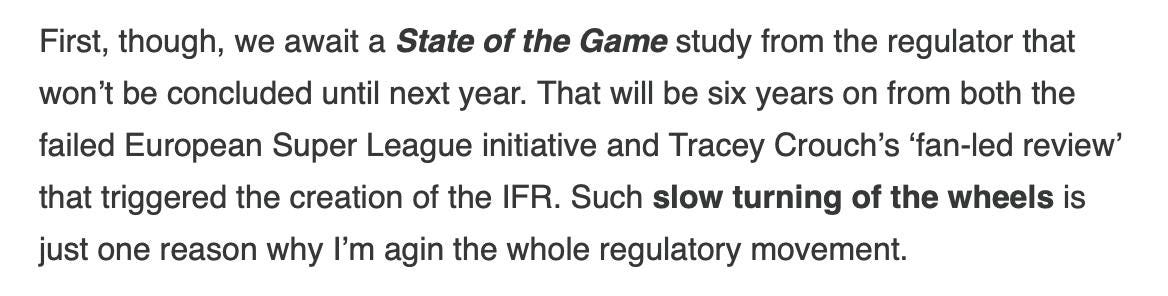
This next one is from Ed Warner’s Sport Inc newsletter: