Skip to Content

Richard Gillis

68 posts

Posts by Richard Gillis

The Taylor Swift Data Fallacy - the ceiling not the floor

Source: The YouTube Arguments

Why has Mr. Beast’s Beast Games underperformed on Amazon despite $100 million budget, why did The Sidemen drop from 73 million YouTube views to 2.4 million on Netflix, why did Pop the Balloon see similar declines?

The mistake: assuming top-tier creator success represents the average outcome when creators migrate platforms. It’s the ceiling, not the floor. Most creators moving to streaming miss the charts entirely. The best performers are acquisitions like The Amazing Digital Circus—where Netflix paid bargain prices after creators shouldered all risk.

What happened to 'broadcast quality'?

Traditional notions of “quality”, dictated by producers and broadcasters, have inverted. Audiences define quality based on interest, not technical specifications. A Roblox game with “16-bit console from 25 years ago” aesthetics can attract 25 million concurrent users (World Cup final numbers). Jen Topping identifies emerging demand for sophisticated storytelling as AI slop floods platforms. Professional production may find opportunity precisely because trustworthy, authentic content becomes scarce. The challenge: platform economics reward sameness.

The four problems to solve

The race to build SportsbizGPT is happening downstream of the bigger fight being waged by the foundational models.

There are four problems to be solved, and the company which solves each of them will be ‘generational’. That's how Jonathon Ross, CEO of Groq sees it.

@20vc_tok

The 4 future opportunities in AI 🤖 20VC with Groq Founder & CEO Jonathan Ross. Link in bio.⁠ —⁠ HarryStebbings Business businesstips businessadvice entrepreneur ceo startup founder entrepreneurship ai artificialintelligence grok nvidia futuretech techtok #careertips

♬ original sound - 20VC - 20VC

The four problems represent the evolutionary stages that AI companies must solve to reach full potential:

  1. The Hallucination Problem: This is the first and most critical hurdle to overcome. It involves ensuring that models do not generate false or fabricated information, which is a foundational requirement before more complex tasks can be reliably automated.
  2. Breaking Down Sub-goals for Agentic AI: Once hallucinations are addressed, the next challenge is enabling AI to effectively deconstruct large objectives into smaller, actionable sub-goals. Solving the hallucination problem first is vital here because long chains of agentic tasks are currently prone to introducing errors and "hallucinations" that can derail the entire process.
  3. The "Invent" Stage: Currently, Large Language Models (LLMs) function by making the most probable prediction, which results in predictable and often "terrible" creative output in art and writing. The challenge for the "invent" stage is to move beyond probability to generate insights or content that are non-obvious yet clearly correct once they are seen.
  4. The Proxy Stage: The final stage is reached when a model can effectively proxy decisions for the user. This involves the model acting with the level of trust and authority granted to a Chief of Staff or Executive Assistant, making autonomous choices regarding logistics, scheduling, and priorities—such as deciding which interviews to take and which flights to book.

This progression is similar to climbing a ladder where each rung must be secure before reaching for the next; you cannot trust an AI "Proxy" to handle your entire schedule (the top rung) if it still "hallucinates" your destination or fails to understand the "sub-goals" of travel logistics (the bottom rungs).

Jonathan Ross’s third bullet point is the most interesting and relevant to the SportsbizGPT question. 

The Invent Stage is about the machine providing non-obvious answers.

From here you get to the ‘proxy stage’, when you can trust an LLM to make decisions on your behalf. Because making decisions is a creative act. It requires selecting one option and forgoing others. 

Each of the four problems will be solved by ‘an industry defining tech company’. That’s the big race. And it will set off a series of other races. 

Who will build the machine that makes real sense of sports media, betting, ticketing and fan engagement datapoints? 

Whoever it is, they’ll be rich.

Infinite Athlete is in a long queue to be the Bloomberg terminal for Sport

This builds on a previous thread: The Unofficial Second Brain

The race is on to productise LLMs and make them specific for the sports business (Clickbait title)

In January 2025 we had Charlie Ebersol, founder of Infinite Athlete on the podcast. I didn’t come out of the chat with any real sense of what Infinite Athlete is beyond an aspiration to be ‘the Bloomberg terminal for sport’, which takes in multiple data sources and turns them in to something useful. That podcast is here:

Make my logo bigger

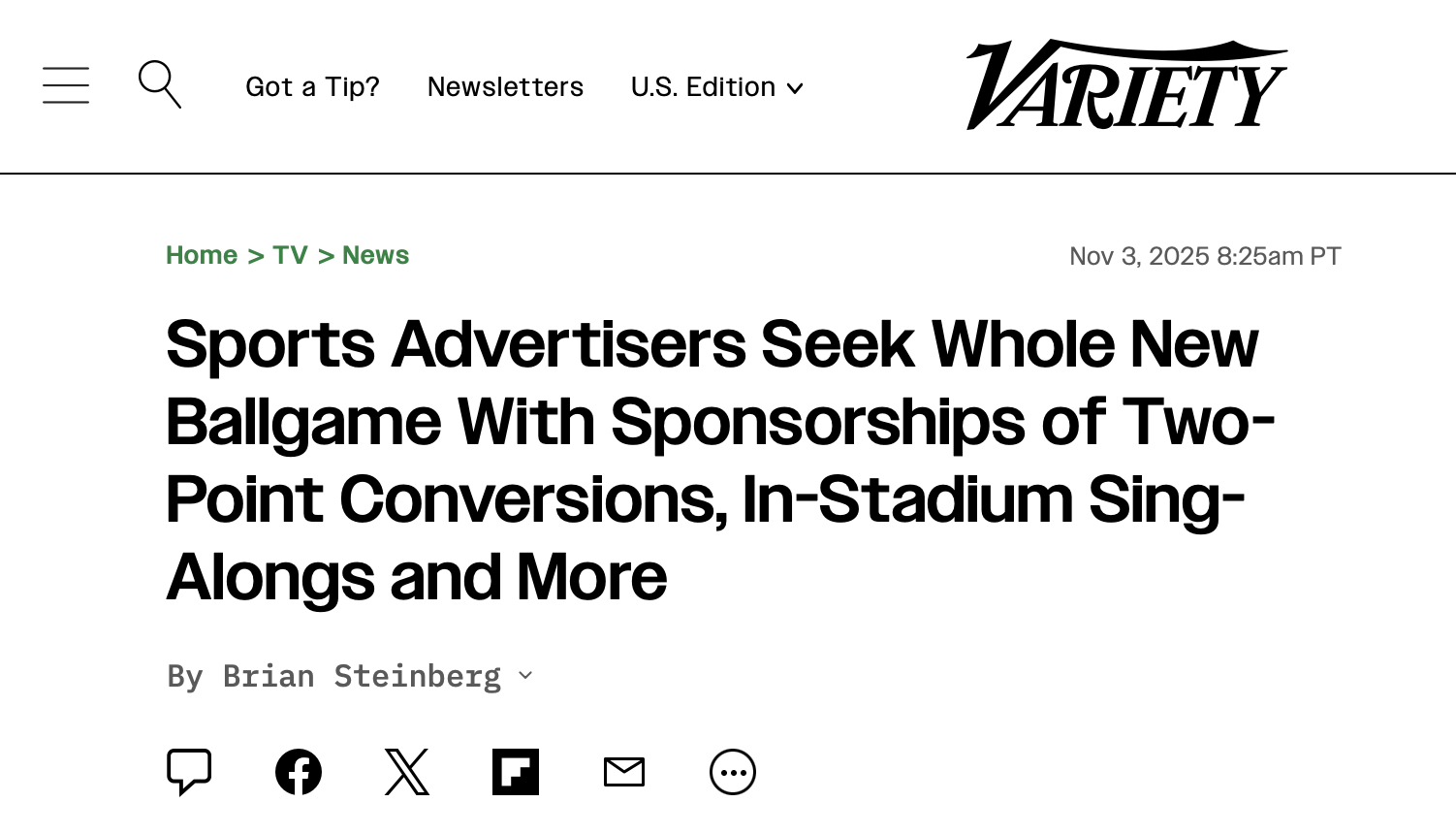
Variety reports on the pressure to get brands in to the live feed. A story as old as advertising has existed.

Whether this is a story or a non-story rests on whether you think the media side has the strength of will to defend the integrity of the product now.

We're in a weird time, when nobody is happy. TV viewers, sports fans, music buyers...everyone is pushing back on the over- commercialisation of their thing.

Just this week, we've had the same story appear in a different guise, this time on cringeworthy product placement in Netflix's hot rabbi romcom:

https://www.thetimes.com/article/4d1435d4-c337-434c-9bf4-f6622063c1cd?shareToken=a03d07021f9f41811094aab779ebc7cf

And if you venture deeper into the weeds, the same story again, this time with an AI coating:

The Open Web is Over: Here’s What’s Next and Why It Favors Individuals and Small Brands, not Big Companies (+7 Prompts to Help)
Everyone agrees the open web is dying. No one agrees what comes next. This post brings clarity: I dive into how AI is changing the web, and give you proven principles and prompts to gain an edge.

Each of these three stories are about the deep worry on the brand side that their route to the consumer is blocked.

In each case the answer is a variation of make my logo bigger.

Meanwhile, the consumer pays twice, once with money, then again with their attention and the irritation at having their thing covered in ads.

But who pays for the content if the ads don't work, is the cry.

The answer is obvious, but one that nobody on the publisher side wants to hear: Control costs. Stop overpaying for talent. Grow a pair.

🤖 Why p/e is buying up talent agencies

🤖 Unofficial Briefing: Private Equity, Scale, and the Evolution of the Sports Talent Agency Market

Context: This briefing summarises a conversation examining the accelerating trend of consolidation and private equity (PE) investment in sports talent representation, analysing the financial drivers, operational challenges, and future direction of these scaled-up agencies. The series explores "sport and investment and, you know, money in a broader sense and its impact".


1. Market Consolidation and PE Investment

The sports agency sector is undergoing rapid corporatisation marked by significant consolidation. Recent examples include Bruin Capital purchasing four firms to form Nomi Sports/As One (N O M I) and various acquisitions involving major entities like CAA, Wasserman, and Endeavor.

  • Financial Rationale: Private equity firms are drawn to this market primarily because it offers a "double whammy" for investment growth. They can increase value by growing the absolute profit number (scaling) and simultaneously raising the multiple of profit achievable upon exit.
  • Recurring Revenue Stream: Player agencies provide relatively low risk businesses in sport because commission income (typically 10% of a deal) is received annually for the duration of a player’s contract.
  • Operational Efficiency: PE investment is aimed at professionalising operations. While many agents are "excellent salespeople, really strong in relationships," they may not be "the most savvy of business managers". PE firms speculate they can enhance inherent profitability by providing skills to improve cash flow and the operational side of the business.
"So if Bruin think okay we can make this business more inherently profitable because we can make it more efficient so that will grow the profit line and we can layer up recurring profit to increase the multiple line, we've got a double whammy there."

2. De-Risking and the Shifting Agency Role

Traditional football agency revenue is inherently unstable due to the short, typically two-year, duration of player representation contracts. Agencies are therefore pursuing strategies to de-risk their business models and expand their revenue streams.

  • Scale as Stability: Agencies de-risk by securing large volumes of clients, ensuring they are not dependent on a few superstar clients whose contracts may lapse. An agency wants "500 players... constantly renewing two year deals" rather than three or four good players on two-year deals.
  • Rise of the Brokerage Market: Larger agencies are increasingly focused on brokering deals rather than solely representing players. This involves leveraging "extremely strong sporting relationships with the sporting directors, chief executives" to facilitate high-value transfers, especially into "the big buying leagues, one of those being the Premier League".
  • Entertainment Intersection: Consolidation is also driven by the view that football is "just another silo of a sector" within broader entertainment spheres, allowing for opportunities in music, film, and TV.
"De risking is also the case because of that two year instability, but also because you, you don't want to just be dependent on one, you know, income source, line, line revenue source, which is player stuff."

3. Challenges of Scale and Internal Competition

While scale provides financial security and market knowledge, it introduces complexity, internal challenges, and external pressures.

  • Market Squeeze: The agency market is "getting tougher". Clubs limit agents' ability to secure commercial deals by claiming significant portions of players' image rights revenue (e.g., Real Madrid reportedly taking 50%) and restricting commercial partners who might conflict with club sponsors.
  • Operational Friction: Increased size makes internal communication and alignment difficult. Within a large agency, agents may be "in competition with each other as much as they are with someone on the outside". This "internal competition can lead to sometimes very aligned incentives and sometimes very misaligned incentives".
  • Loss of Agility: Large agencies risk becoming "cookie cutter agency[s]", potentially lacking the agility to "bespoke a service" around the unique needs of individual athletes (e.g., social media support versus sophisticated P.E. support for a natural entrepreneur).
  • PE Alignment as a Solution: External PE investment can mitigate internal conflict by offering shares in the upside and aligning the senior team around a future exit value, moving away from individual performance bonuses toward a "socialist kind of culture internally".
"It's all of that and even more so, which is, you know, sometimes, uh, and I've seen it work both ways seamlessly and with difficulty, which is the bigger you get, the harder the comms pieces."

The conversation highlighted American investment and the evolving financial relationship between high-earning athletes and their business partners.

  • American Influence: American investors are leveraging their experience in the talent market to enter European football as a way of capitalising on the superstar athlete as brand trope while "hedging against the sort of daftness or the volatility of European football" clubs.
  • Wealth Management: As athlete wages increase, there is a growing necessity and opportunity for agencies to provide sophisticated financial services advice. This includes helping athletes move beyond short-term earnings to make "long term smart decisions with their income" and strategically invest in enterprises like sports tech.
  • Equity over Cash: A future trend suggests players may seek equity in sports properties rather than solely accepting high salaries, viewing themselves as significant pieces of intellectual property (IP). Examples include players deferring salary for "0.5 percent in Arsenal Women's" or seeking stakes in start-ups.
"I think the next few years are the years of players realizing they're a much bigger piece of the team landscape than just actually talent on pitch or on court and how you translate and how agents begin to translate that into equity."