Is it to do with betting?
@golfdigestofficial Jordan Spieth says sports betting has caused fan behavior at PGA Tour events to change #golf #fyp #golftiktok #golftok
♬ original sound - Golf Digest
Is it to do with betting?
@golfdigestofficial Jordan Spieth says sports betting has caused fan behavior at PGA Tour events to change #golf #fyp #golftiktok #golftok
♬ original sound - Golf Digest
A story is building that AI is the next era defining sponsorship category.
The dream scenario for the sports sector is that this is true.
It has the characteristics required.
Undifferentiated brands backed by vast sums of OPM.
So, forward five years.
Two thirds of Premier League shirts carry AI brands.
Cue rumbling from legislators about the dangers of AI to children and mental health.
I'd model a ban by 2035.
By which time any societal harm inflicted will be baked in. The money will be in the sports 'ecosystem' and the next big category will emerge. It's a circle of life thing. Cue Lion King gif.
A semi-regular thread🧵on the podcast relates to why some sports and properties are popular as betting sports, and what happens if a rights holder purposely seeks to frame their sport to the gambling marketplace.
The follow on from this is how investors and private equity groups are very interested in this question. I find myself over using George Pyne as a case study, citing his enthusiasm for TGL, the screen golf series, as a betting platform.
From here, the conversation can jump quickly to the hypothetical of turning women's sport in to a 'betting sport'.
So I'm really interested in this great bit of journalism from Play the Game:
 Stanis Elsborg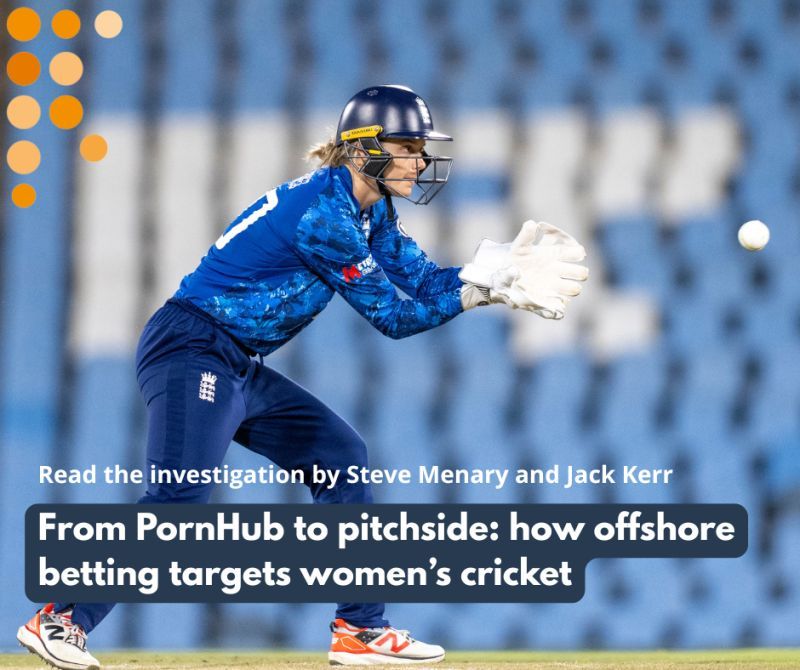
Nikola raises another betting angle below, this time re Gen Z's appetite.
This touches on one of the UP Rules: Fan Engagement is a euphemism for betting.
Nikola Vuković, CFA
This podcast has been one of our best performing. Not a surprise, Simon Denyer is one of the smartest guys in the room.
Part of the conversation was about betting.
A question I've asked a few times on the podcast is about where betting sits in the private equity playbook.
I was struck by how bullish George Pyne was on TGL, and how explictly he referenced it as a potential betting product.
The p/e money likes betting for semi-obvious reasons to do with risk diversification and revenue predictability.
As Denyer notes, when evaluating sports investments, "a sport that has a second or third main revenue stream is really interesting compared to a sport that relies on TV for 90% of the money... you've got a material second revenue stream, and sometimes it's actually bigger than sponsorship."
There's a strong link between betting and other forms of fan engagement.
Sports that generate betting interest typically indicate passionate fan bases willing to spend money on that interest, which can translate across multiple revenue streams - merchandise, ticketing, premium content subscriptions blah blah blah.
This diversification appeal operates on multiple levels: Television rights face cyclical pressures from broadcaster consolidation, cord-cutting, and economic downturns. Betting revenue operates on different market dynamics - it's driven by fan engagement rather than media company budgets.
When Sky reduces sports rights spending, betting turnover on those same matches may actually increase as fans seek alternative engagement methods. Unlike broadcast rights that face intense bidding wars and regulatory intervention, betting data deals offer more stable, long-term revenue with predictable margin structures.
The "official data feed" model creates natural monopolies that resist competitive pricing pressure. A sport with strong betting appeal can monetize audiences in markets where broadcast rights generate minimal value, lending a bit of oomph to a rights holder's international strategy. Given this is how the investors think, there's an obvious incentive for individual rights holders to make their sport more 'betting friendly', to take advantage of the arguments laid out above. (We'll park the shouldquestions for a moment).
>>What if…<<
Just for sake of provocation, what would happen if we took a major women's soccer league and pointed it toward this question.
Traditional broadcast rights remain limited outside major tournaments, sponsorship deals lag behind men's equivalents, and attendance revenue varies dramatically by market. Unlike men's football where betting represents supplementary income, for women's leagues it could become a primary revenue driver during the growth phase.
Adding meaningful betting revenue could provide the financial foundation for league sustainability and player compensation improvements.
Women's football generates substantial in-play betting interest during major tournaments - the World Cup and Euros see significant betting volumes. But this engagement doesn't translate to regular league matches because betting operators lack comprehensive data feeds and league betting markets remain underdeveloped. Creating systematic betting data partnerships could establish year-round revenue streams independent of broadcast deal negotiations.
But.
You run in to the c word. Culture.
The (or, A) current trajectory of women's football is as a purpose-led family-friendly product - an alternative to the 'over-commercialised' excess of men's elite football.
Betting runs against that narrative.
Simon Denyer's analysis reveals the fundamental limitation: "It is very, very easy to create a new product... very different to completely changing behavior." 20% of sports fans bet. "That 20% who bet do so primarily on sports they already follow intensively".
The sports that successfully leverage betting revenue - tennis, golf, men's football - had established passionate followings before betting integration. They didn't use betting to create fan interest; they monetized existing interest through betting channels. Chicken, egg.
The other problem is data, or the lack of it.
"You look at how much revenue is being turned over on Serie A Football in Italy... then you go, well, how much of that is in-play? Right. And you'd be amazed. It's like sometimes it's 90%... If 90% of it's in-play... these are all things that require data, and these are all things that are enhanced by having the live video stream."
So the betting angle presents both opportunity and trap. The diversified revenue argument appears compelling, but depends on achieving sufficient scale to generate meaningful betting turnover. This requires substantial upfront investment in data infrastructure, marketing, and content creation without guaranteed returns. The timeline mismatch creates additional complexity. PE investment horizons typically span 5-7 years, but building betting-friendly sports requires behavioral change that operates on longer timescales. The revenue diversification benefits may not materialise within typical investment windows.
More fundamentally, optimizing women's football for betting appeal could undermine rather than enhance the current model, conflicting with broadcast appeal, attendance growth, or youth participation. These competing priorities could fragment development efforts and reduce overall investment effectiveness.
Denyer quotes:
Why the Betting-Broadcasting Convergence Dream Died:
"I don't necessarily agree with convergence of betting and sports broadcasting... there's been one good example of it, which was Sky owning SkyBet. They did a brilliant job of driving subscribers to SkyBet... But I don't think there's been many, many more, and I don't think it's really critical.
The Living Room vs Mobile Reality Check:
"My viewing experience, like most people's now is connected TV, right? I want the best viewing experience for my live sport. So that's on a connected TV. That is not a great place to stick a betting app or betting functionality. It's really clunky... you're suddenly trying to do an accumulator with five different bets whilst on your remote control. It's just not gonna happen.
Betting boosts advertising revenue but don't bet the house on it
"Although it may appear to you to be quite a large piece of the inventory, as a viewer, it's still a relatively small part of the revenue... you are talking maximum 10% from advertising overall. And let's say betting is 30% of that max... So it's kind of from zero to 3% of the overall mix. So it's not as big as you realize."
'This is a bad idea. It is a very, very, very bad idea'.
Substack just did a deal with Polymarket.
From that link to Brian Moritz:
Imagine for a second that instead of Polymarket, this was FanDuel announcing an exclusive partnership with Substack. Or Draft Kings. What would your reaction be? What would everyone’s reaction be?