Skip to Content

Richard Gillis

54 posts

Posts by Richard Gillis

Infinite Athlete is in a long queue to be the Bloomberg terminal for Sport

This builds on a previous thread: The Unofficial Second Brain

The race is on to productise LLMs and make them specific for the sports business (Clickbait title)

In January 2025 we had Charlie Ebersol, founder of Infinite Athlete on the podcast. I didn’t come out of the chat with any real sense of what Infinite Athlete is beyond an aspiration to be ‘the Bloomberg terminal for sport’, which takes in multiple data sources and turns them in to something useful. That podcast is here:

Make my logo bigger

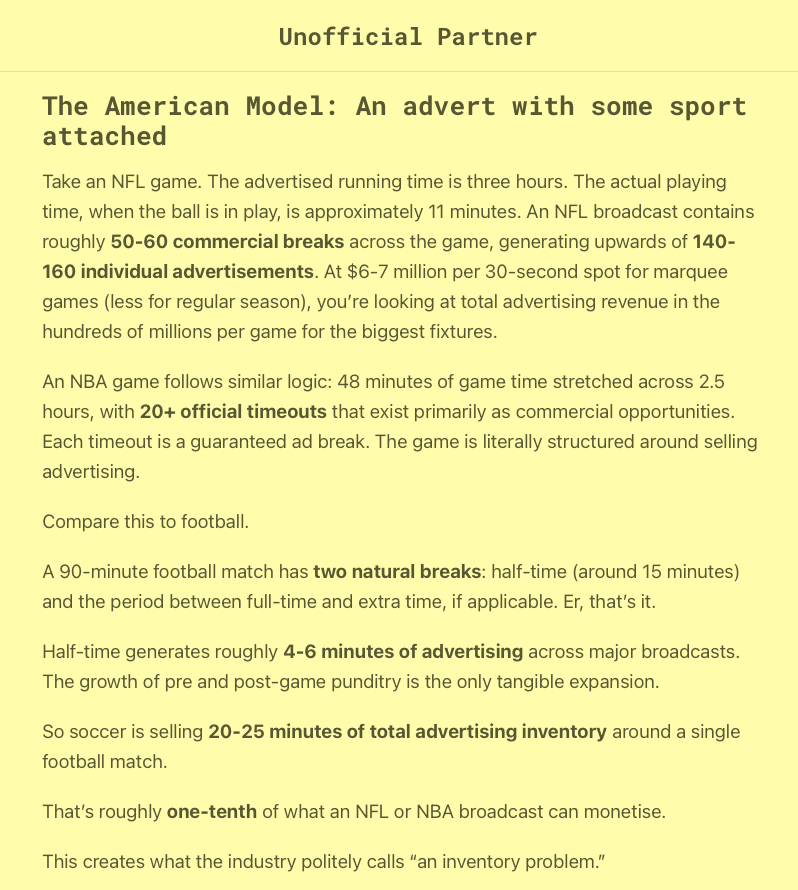
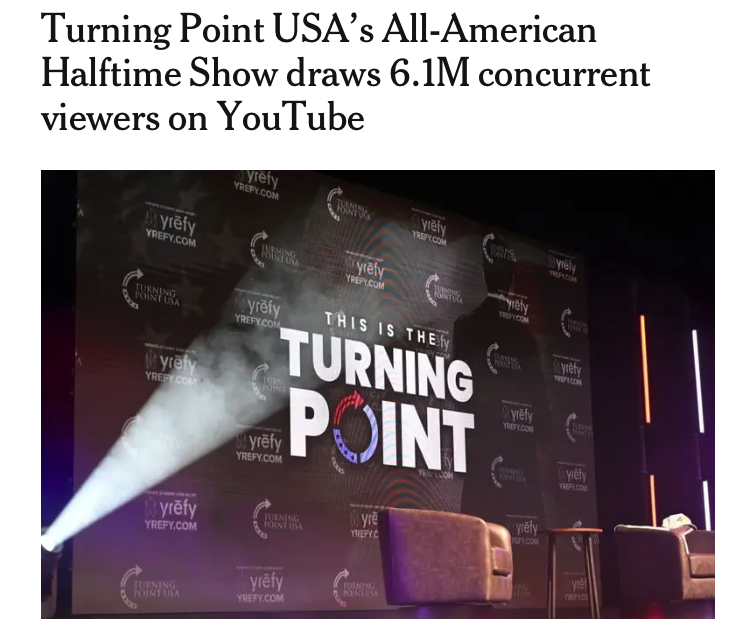
Variety reports on the pressure to get brands in to the live feed. A story as old as advertising has existed.

Whether this is a story or a non-story rests on whether you think the media side has the strength of will to defend the integrity of the product now.

We're in a weird time, when nobody is happy. TV viewers, sports fans, music buyers...everyone is pushing back on the over- commercialisation of their thing.

Just this week, we've had the same story appear in a different guise, this time on cringeworthy product placement in Netflix's hot rabbi romcom:

https://www.thetimes.com/article/4d1435d4-c337-434c-9bf4-f6622063c1cd?shareToken=a03d07021f9f41811094aab779ebc7cf

And if you venture deeper into the weeds, the same story again, this time with an AI coating:

The Open Web is Over: Here’s What’s Next and Why It Favors Individuals and Small Brands, not Big Companies (+7 Prompts to Help)
Everyone agrees the open web is dying. No one agrees what comes next. This post brings clarity: I dive into how AI is changing the web, and give you proven principles and prompts to gain an edge.

Each of these three stories are about the deep worry on the brand side that their route to the consumer is blocked.

In each case the answer is a variation of make my logo bigger.

Meanwhile, the consumer pays twice, once with money, then again with their attention and the irritation at having their thing covered in ads.

But who pays for the content if the ads don't work, is the cry.

The answer is obvious, but one that nobody on the publisher side wants to hear: Control costs. Stop overpaying for talent. Grow a pair.

🤖 Why p/e is buying up talent agencies

🤖 Unofficial Briefing: Private Equity, Scale, and the Evolution of the Sports Talent Agency Market

Context: This briefing summarises a conversation examining the accelerating trend of consolidation and private equity (PE) investment in sports talent representation, analysing the financial drivers, operational challenges, and future direction of these scaled-up agencies. The series explores "sport and investment and, you know, money in a broader sense and its impact".


1. Market Consolidation and PE Investment

The sports agency sector is undergoing rapid corporatisation marked by significant consolidation. Recent examples include Bruin Capital purchasing four firms to form Nomi Sports/As One (N O M I) and various acquisitions involving major entities like CAA, Wasserman, and Endeavor.

  • Financial Rationale: Private equity firms are drawn to this market primarily because it offers a "double whammy" for investment growth. They can increase value by growing the absolute profit number (scaling) and simultaneously raising the multiple of profit achievable upon exit.
  • Recurring Revenue Stream: Player agencies provide relatively low risk businesses in sport because commission income (typically 10% of a deal) is received annually for the duration of a player’s contract.
  • Operational Efficiency: PE investment is aimed at professionalising operations. While many agents are "excellent salespeople, really strong in relationships," they may not be "the most savvy of business managers". PE firms speculate they can enhance inherent profitability by providing skills to improve cash flow and the operational side of the business.
"So if Bruin think okay we can make this business more inherently profitable because we can make it more efficient so that will grow the profit line and we can layer up recurring profit to increase the multiple line, we've got a double whammy there."

2. De-Risking and the Shifting Agency Role

Traditional football agency revenue is inherently unstable due to the short, typically two-year, duration of player representation contracts. Agencies are therefore pursuing strategies to de-risk their business models and expand their revenue streams.

  • Scale as Stability: Agencies de-risk by securing large volumes of clients, ensuring they are not dependent on a few superstar clients whose contracts may lapse. An agency wants "500 players... constantly renewing two year deals" rather than three or four good players on two-year deals.
  • Rise of the Brokerage Market: Larger agencies are increasingly focused on brokering deals rather than solely representing players. This involves leveraging "extremely strong sporting relationships with the sporting directors, chief executives" to facilitate high-value transfers, especially into "the big buying leagues, one of those being the Premier League".
  • Entertainment Intersection: Consolidation is also driven by the view that football is "just another silo of a sector" within broader entertainment spheres, allowing for opportunities in music, film, and TV.
"De risking is also the case because of that two year instability, but also because you, you don't want to just be dependent on one, you know, income source, line, line revenue source, which is player stuff."

3. Challenges of Scale and Internal Competition

While scale provides financial security and market knowledge, it introduces complexity, internal challenges, and external pressures.

  • Market Squeeze: The agency market is "getting tougher". Clubs limit agents' ability to secure commercial deals by claiming significant portions of players' image rights revenue (e.g., Real Madrid reportedly taking 50%) and restricting commercial partners who might conflict with club sponsors.
  • Operational Friction: Increased size makes internal communication and alignment difficult. Within a large agency, agents may be "in competition with each other as much as they are with someone on the outside". This "internal competition can lead to sometimes very aligned incentives and sometimes very misaligned incentives".
  • Loss of Agility: Large agencies risk becoming "cookie cutter agency[s]", potentially lacking the agility to "bespoke a service" around the unique needs of individual athletes (e.g., social media support versus sophisticated P.E. support for a natural entrepreneur).
  • PE Alignment as a Solution: External PE investment can mitigate internal conflict by offering shares in the upside and aligning the senior team around a future exit value, moving away from individual performance bonuses toward a "socialist kind of culture internally".
"It's all of that and even more so, which is, you know, sometimes, uh, and I've seen it work both ways seamlessly and with difficulty, which is the bigger you get, the harder the comms pieces."

The conversation highlighted American investment and the evolving financial relationship between high-earning athletes and their business partners.

  • American Influence: American investors are leveraging their experience in the talent market to enter European football as a way of capitalising on the superstar athlete as brand trope while "hedging against the sort of daftness or the volatility of European football" clubs.
  • Wealth Management: As athlete wages increase, there is a growing necessity and opportunity for agencies to provide sophisticated financial services advice. This includes helping athletes move beyond short-term earnings to make "long term smart decisions with their income" and strategically invest in enterprises like sports tech.
  • Equity over Cash: A future trend suggests players may seek equity in sports properties rather than solely accepting high salaries, viewing themselves as significant pieces of intellectual property (IP). Examples include players deferring salary for "0.5 percent in Arsenal Women's" or seeking stakes in start-ups.
"I think the next few years are the years of players realizing they're a much bigger piece of the team landscape than just actually talent on pitch or on court and how you translate and how agents begin to translate that into equity."

Enshittification

Enshittification
Photo by John Cardamone / Unsplash

🤖 Briefing: How digital platforms degrade over time

Note: 🤖 indicates the following material is derived using Chat_UP, Unofficial Partner's language model trained on our podcasts and newsletters.

Enshittification is Cory Doctorow's term to describe the cyclical degradation of online platforms. The central thesis is that the decline of digital services is not an accident or a result of corporate incompetence, but a deliberate, multi-stage process driven by a policy environment that has eliminated the traditional disciplines of competition, regulation, and user empowerment.

Enshittification follows a predictable three-stage lifecycle:

  1. Attract End Users: Platforms begin by offering a high-quality, valuable service to attract a large user base, often at a loss.
  2. Attract Business Customers: Once users are locked in (e.g., through social graphs or high switching costs), the platform degrades the user experience to benefit business customers (e.g., advertisers, publishers), who are then also locked in.
  3. Extract Value for the Platform: With both users and business customers captive, the platform extracts all surplus value for itself and its shareholders, leaving only a "mingy homeopathic residue" sufficient to keep participants from leaving.

This process is not the fault of uniquely "bad CEOs" but is an effect of a systemic failure. Doctorow identifies the erosion of four key disciplines that once prevented this behavior: competitionregulationself-help (interoperable technology), and a principled workforce. The most potent weapon in dismantling these disciplines has been the expansion of intellectual property law, particularly the Digital Millennium Copyright Act (DMCA), which criminalizes the creation of tools that allow users to modify their own devices and services, thereby eliminating interoperability as a competitive check on platform power.

Case studies like the intentional degradation of Google Search, Amazon's monopolization of the audiobook market via Audible, and the proliferation of "pain-point pricing" in hardware demonstrate this theory in action. The proposed solution is not individual consumer choice but large-scale, structural policy change. Doctorow points to a recent and unprecedented global surge in antitrust enforcement as a hopeful sign that a broad, cross-sectional movement against oligarchic control is beginning to succeed, even before it has a unified identity.

--------------------------------------------------------------------------------

The Theory of Enshittification

A Precise Technical Definition

Coined by Cory Doctorow, "enshittification" describes the specific, predictable process by which digital platforms decay. While used colloquially to mean "things getting worse," its technical meaning refers to a deliberate cycle of value allocation and extraction endemic to digital intermediaries.

"I coined it with a very precise technical meaning, uh, a meaning that relates to the specific contours of how digital platforms go bad."

The Three-Stage Cycle of Platform Decay

Platforms, defined as intermediaries connecting two or more groups (e.g., buyers and sellers on Amazon, drivers and riders on Uber), decay in three distinct stages.

Stage

Action

Primary Beneficiary

Description

1

Seduce Users

End Users

The platform offers a superior service, often at a loss, to attract a critical mass of end users and lock them into a "roach motel" where switching costs are high.

2

Seduce Businesses

Business Customers

The user experience is degraded to create value for business customers. For example, Facebook began spying on users and inserting unwanted content into their feeds to create a valuable product for advertisers.

3

Extract Value

Platform/Shareholders

With both users and businesses locked in, the platform claws back all surplus value for itself, degrading the service for everyone involved. The quality is lowered to the bare minimum required to prevent mass exodus.

This model refutes the common axiom, "If you're not paying for the product, you're the product." Doctorow provides numerous examples, from advertisers on Facebook to traders on Robinhood, where paying customers are abused just as readily as non-paying users once they are locked in.

--------------------------------------------------------------------------------

The Central Question: Why Is This Happening Now?

The phenomenon of enshittification is not attributed to the moral failings of individual executives like Mark Zuckerberg. Doctorow notes that platforms were often better stewards under the same leadership in earlier eras. The change is not in the people, but in the environment.

"Mark Zuckerberg is smart enough to be the cause of enshitification. He is the effect. There is a Mark Zuckerberg shaped sociopathic hole in the digital fabric that was put there by policymakers."

The core argument is that the policy environment has been deliberately altered to favor enshittification by removing the disciplines that once constrained corporate behavior.

The Four Lost Disciplines

  1. Competition: Decades of lax antitrust enforcement have allowed tech giants to buy or crush potential competitors, eliminating market pressure to provide good service. The "acquihire" model, where startups aim for acquisition by a giant rather than building a sustainable business, is a symptom of this.
  2. Regulation: A shift in regulatory philosophy, particularly the "consumer welfare" standard adopted in the Reagan era, assumes monopolies are efficient and self-correcting. This has led to regulatory capture and a failure to enforce existing laws, even when companies openly admit to anti-competitive behavior.
  3. Self-Help (Interoperability): The ability for users and third parties to modify or build upon a service to "disenshittify" it. This powerful check on platform power has been systematically dismantled by intellectual property laws.
  4. A Powerful Workforce: The presence of "Tron Pilled" employees—those who believe in the mission to "fight for the user"—who could resist internal directives to harm users has diminished.

Case Studies in Enshittification

Google's decline is presented as a textbook case of deliberate enshittification driven by the need to show perpetual growth to markets.

  • Monopoly Creation: A 2024 federal court ruling found that Google illegally procured and maintained its 90% search market share through anti-competitive deals, such as paying Apple over $20 billion annually to be the default search engine.
  • The Growth Imperative: Once a company achieves market saturation, it can no longer grow at the rate markets expect of a "growth company." This threatens its high stock valuation (price-to-earnings ratio), which in turn affects executive compensation and the ability to acquire other companies with stock.
  • The Internal Conflict: Leaked emails from a DOJ lawsuit reveal a conflict between Pragavar Ragavan, who was in charge of search revenue, and Ben Gomes, a long-time engineer focused on quality. Ragavan's solution to the growth problem was to intentionally worsen search results by disabling features like spell-checking and synonym searches. This forced users to search multiple times, doubling or tripling the number of ad impressions and creating artificial "growth."
  • The Kaggi Revelation: A paid search engine called Kaggi provides results "like Google used to be." It was later revealed that Kaggi is primarily a front-end for Google's own search results, which Kaggi's small team simply re-ranks. This serves as definitive proof that Google's decline is a choice. As Doctorow states, "Google sucks because Google wants to suck."

The ability of users to engage in "self-help" through interoperable products (e.g., ad blockers, third-party accessories) is the most powerful deterrent to enshittification. This has been systematically criminalized.

  • The Power of Interoperability: Because all modern computers are "Touring complete" universal machines, it is always technically possible to create a tool to improve or alter a digital service. Doctorow calls this the "11-ft disenshittifying ladder" for every "10-ft pile of shit."
  • DMCA Section 1201: This 1998 law makes it a felony—punishable by a 5-year prison sentence and a $500,000 fine—to circumvent a "digital lock" (DRM).
  • Consequences:
    • Apps vs. Web: Ad blockers are common on web browsers. However, they are illegal for mobile apps because apps are wrapped in DRM. This is why companies are "so horny" for users to switch from their websites to their apps.
    • Hardware Lock-in: The DMCA extends beyond software to any device with a chip. This enables companies to use DRM to block third-party replacements for products like printer ink cartridges, GE refrigerator water filters, and more.
    • The Adobe Pantone Case: Adobe used its cloud-based software to remove support for industry-standard Pantone colors, breaking users' old design files unless they paid a new, separate $21/month fee directly to Pantone. This transfer of cost from corporation to customer was only possible because the software was locked down.

Chokepoint Capitalism: The Audible Monopoly

Amazon's subsidiary, Audible, controls over 90% of the audiobook market and uses DRM as a weapon to maintain this "chokepoint."

  • Mandatory DRM: Audible forces all publishers and independent authors to wrap their audiobooks in its proprietary DRM as a condition of sale.
  • Permanent Lock-In: Because of the DMCA, it is a felony for anyone—including the original author and copyright holder—to create a tool that would allow a customer to move their legally purchased audiobooks to a competing platform.
  • Hostage Libraries: A customer's library, potentially worth thousands of dollars, becomes a switching cost that locks them into the Audible ecosystem forever. This gives Amazon absolute power over creators and consumers. The penalty for creating a conversion tool is more severe than for pirating the book or even robbing a delivery truck at gunpoint.

The Human Cost: Pain-Point Pricing

The combination of mass surveillance and locked-down technology enables a new business model: identifying and monetizing human desperation.

  • Definition: Using surveillance data ("telemetry") to identify the most critical features of a product, remove them, and then sell them back to the user as an upsell at a moment of vulnerability. A Delta Airlines CEO described this as pricing "around your pain points."
  • Examples:
    • Smart baby monitors that wall off essential notifications (e.g., "your baby woke up") behind a new monthly subscription fee.
    • Subprime auto loans that include devices to remotely disable a car's ignition or blast ear-splitting debt collection demands through a second audio system.
    • Mobile phone lenders in India that use undeletable spyware to disable a user's most-used apps one by one if a payment is missed.

Solutions and a Path Forward

Doctorow is clear that individual action and consumer choice are insufficient solutions. The problem is structural and requires a collective, political response.

Strategies for Creators

While acknowledging the limits of individual advice, Doctorow suggests creators should focus on mitigating lock-in.

  • Understand Platform Motives: Platforms treat you well out of fear of you leaving, not out of sentimentality.
  • Resist Lock-in: Be wary of platform features (like Substack's recommendation engine) that increase dependence, even if the core asset (like an email list) remains portable.
  • Practice Digital Hygiene: Regularly export all data (e.g., download your mailing list weekly) to maintain the option of leaving.
  • Explore Alternatives: Consider platforms like Ghost, which may offer more favorable terms and greater control, particularly if self-hosted.

Structural Solutions for Society

The only effective solution is to restore the disciplines that prevent enshittification through collective political action.

  • Reject Consumerism as Politics: "Voting with your wallet" is a losing strategy, as the wealthiest always have more votes. Change requires acting as a polity, not as individual consumers.
  • Join a Movement: Organizations like the Electronic Frontier Foundation (EFF) and its local affiliates provide a structure for coordinated action on digital rights and policy.
  • A Hopeful Turn: There is an unprecedented global wave of antitrust activism. Regulators in the US, Canada, UK, EU, China, and elsewhere are challenging corporate power in ways not seen in living memory. This is evidence that public pressure is working.
  • The "Ecology" Analogy: Like the environmental movement before the term "ecology" unified disparate causes (saving owls, protecting the ozone layer), people fighting against various forms of oligarchic control are part of a single, powerful movement. Recognizing this shared struggle is the key to victory.

"Something has changed in the way that the public conceives of its relationship to power. And it is creating a tailwind that is causing politicians to act in ways that we have not seen them act in living memory... the only way to explain it is that the people are starting to win."

The FA Player - early or wrong?

What the end of The FA Player means and what it probably doesn’t mean

The FA Player cost about £2million.

It was the governing body’s owned and operated play, built by StreamAMG.

The death knell for the service was the last WSL rights deal, which went big on YouTube over OTT.

The FA will be criticised, because that’s what The FA is there for. Like the BBC, NHS and the Church of England, they are the biggest institutions in the country, so attract haters like a magnet.

For late arrivals to this substack, I’ve laid out my priors when it comes to the private-public divide in sport. Warning: contains nuance.

Which is a long way of saying that your views on The FA will likely shape your views on The FA Player: forward-looking test and learn experiment or a publicly funded white elephant?

Anything I write here is unlikely to change your mind.

But let’s use it to ask a couple of questions as to where we are in terms of rights holder strategy.

Life isn’t coding

Fail fast, test and learn, move fast break things blah blah.

Silicon Valley cliches have become sports biz bingo used by people with a commercial axe to grind against the status quo.

But life isn’t coding.

The recklessness of tech developers - see Grok’s latest calamity this week - just doesn’t fit with the big, slow bureaucracies who serve multiple constituencies and which live permanently in the public eye.

That said, failure is feedback - that’s another one - so if something fails, what did we learn?

Was it specific to The FA Player or was it market related?

Was it execution or strategy?

Is YouTube the one and only answer?

If yes, then what happens to the D2C argument, the oft-referenced walled garden of fans?

YouTube is flooding the zone

To click on Linkedin is to be swamped by pro-YouTube propaganda.

Every other post lays out over 400 AI generated words on why moving your sports content to YouTube is the smart guy move.

Jump to X and you quickly run in to an army of growth hack thread monkeys building the same case.

It all feels very orchestrated.

Almost as if these people are being paid, directly or indirectly, by the platform to shove old Joe Overton’s window a few yards their way.

See previous, from 2020: Sport’s Overton Window is on the move

Whatever. It’s working.

We can safely say that as of July 2025 sport is in The YouTube Era, in which the sports market throws its content at the channel, having been through it’s own ‘ build it and they’d better fucking come ’ era of OTT. See The FA Player above.

YouTube's fundamental offer - articulated by Tomos Grace at our EBU event in Bratislava - has not changed in 10 years: it provides reach and audience, allowing rights holders to take a clip of the ad revenue, but it typically does not pay large upfront checks or traditional rights fees.

Despite this, some in the sports industry cling to the belief that YouTube will change tack and join the risk-reward party.

Resisting idiotic binaries

Rights holders are left with the question as to where they put their content to best balance those age old adversaries: discoverability and revenue.

Some global sports acronyms are making high six-figure, low seven figure revenues from YouTube by understanding its role in their funnel and balancing it with their own subscription services.

Balanced against that money is the saving of cost and faff on the supply side. You upload to YouTube and go home.

Note George Pyne’s anecdote at the - I hear excellent - SportsPro investment event yesterday, where the Bruin boss recalled the aggro of Deltatre’s NFL Player launch. OTT is hard and if it goes wrong you get a tiny glimpse of what it must be like being the BBC - see Magnets of Hate, above.

Thinking in bubbles

So, the YouTube Era followed the OTT Era.

Another question nobody knows the answer to: is there a bubble beyond the YouTube Bubble?

Or is that it. The end of history?

Has the screen been won by YouTube and Netflix, and everything else is just nosies off?

Or is there, in the sports space at least, another go around; what might be called OTT 2.0, in which the upside of YT starts to feel like a shit deal and the big sports break for the border with their own, far better owned and operated service which joins the dots with merch, tickets and all the other shit sport sells to its users in a way that looks and feels like Amazon and TikTok.

This is what the money thinks will happen.

Why pile in cash without a thesis that goes beyond pennies on the pound via YouTube and a TV bundle that’s breaking up before our very eyes.

The Wonky Conclusion

Someone clever (Howard Marks to be precise) once said that being too early is indistinguishable from being wrong.

Is that the epitaph of The FA Player?

Nice idea, wrong time?

Does that theory stretch across the sports media landscape more generally?

That the first generation of OTT platforms just weren’t good enough. Too limited. Oversold.

The strategists jumped ten years too far ahead based on the wrong tech.

The idea remains viable.

But it ain’t gonna work on YouTube.

So, cue another tech building programme, more billions chasing the same notion of linking media consumption to fan data platforms, meaningful data lakes and merch and ticket tech stacks.

The LTV CAC wet dream hasn’t really happened yet. The mantra of understanding the fan, capturing first-party data to milk customer lifetime value remains an unattainable pipe dream for most sports bodies.

So, that’s the next pendulum swing, back to D2C and all that.

But there’s a wrinkle.

While sport might aim to be like Amazon or Tesco Clubcard.

Are we expecting Amazon and Tesco Clubcard to stand still?

Or, do they move further ahead, taking with them the customer’s expectations of what is frictionless digital service.

Let’s just agree to not think about that for a couple of years.